



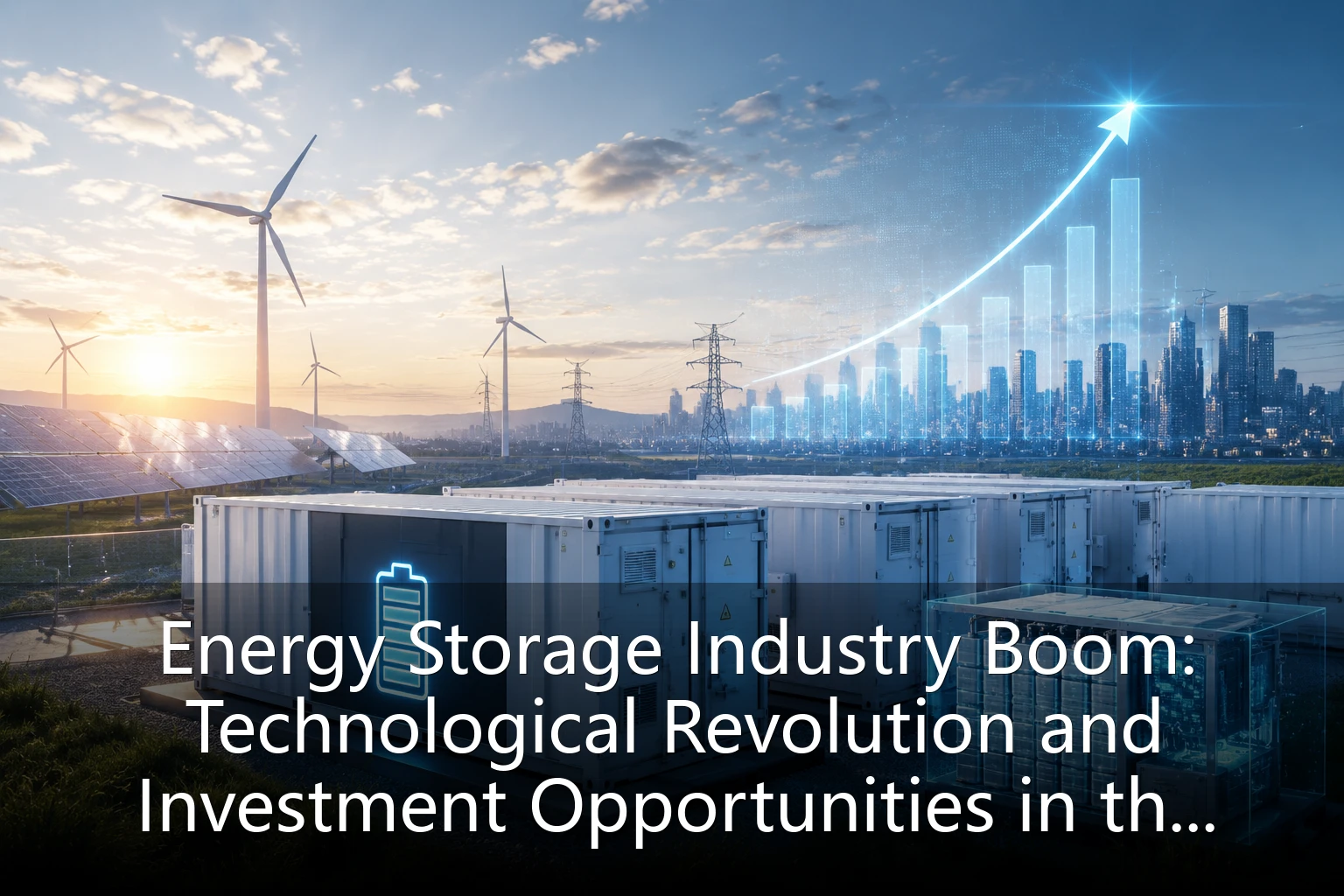
Energy Storage Industry Boom: Technological Revolution and Investment Opportunities in the Energy Bonus Period
\nWith the accelerated transformation of the global energy structure and the continuous increase in the proportion of renewable energy, the energy storage industry is facing unprecedented development opportunities. As a bridge connecting new energy and traditional energy, energy storage technology has become a key support for energy transition. Against the background of the energy bonus period, the energy storage industry has not only received policy dividends but also shown explosive growth in technological innovation, market scale, and investment enthusiasm, opening up a new track for energy investors.
\n\nGlobal Energy Storage Market: From Auxiliary Role to Core Support
\nAccording to the latest industry data, the global installed energy storage capacity exceeded 200GW in the first half of 2026, an increase of over 60% compared to the same period last year, marking the formal entry of the global energy storage industry into a new stage of large-scale development. This milestone achievement not only highlights the increasing importance of energy storage technology in the energy system but also confirms that the energy transition has entered a substantive stage.
\n\nThe explosion of the energy storage industry is not accidental but the result of multiple factors working together. On the one hand, with the continuous increase in global renewable energy installed capacity, especially the rapid growth of photovoltaic and wind power installations, higher requirements have been placed on grid stability. The intermittent and volatile characteristics of renewable energy generation require energy storage systems as a buffer to achieve stable energy output. On the other hand, the profound changes in energy consumption structure, especially the electricity load transfer brought by the popularization of electric vehicles, have further increased the demand for energy storage technology.
\n\nIn terms of regional distribution, the Asia-Pacific region has become the main driving force for the growth of the global energy storage market, accounting for 45% of the newly installed energy storage capacity worldwide in the first half of 2026, with China, India, and Australia showing particularly outstanding performance. The European market follows closely, benefiting from carbon neutrality goals and policy support, with the installed energy storage capacity increasing by more than 50% year-on-year. The North American market leads in technological innovation and application scenario expansion, especially in the residential and commercial energy storage sectors.
\n\nTechnological Innovation: Parallel Development of Diversified Energy Storage Technology Routes
\nThe rapid development of the energy storage industry is inseparable from continuous breakthroughs in technological innovation. Currently, lithium-ion battery energy storage technology still dominates, but cost reduction and technological progress are driving it toward higher energy density, longer cycle life, and higher safety. According to industry data, the cost of lithium-ion battery systems in 2026 decreased by about 65% compared to 2020, significantly shortening the investment payback period for energy storage projects.
\n\nAt the same time, various new energy storage technologies are accelerating the commercialization process. Flow batteries, with their long life and high safety characteristics, show unique advantages in the field of long-duration energy storage, especially suitable for grid-level energy storage applications. Compressed air energy storage technology has cost advantages in large-scale, long-cycle energy storage and has been commercially deployed in multiple countries. Flywheel energy storage plays an irreplaceable role in grid frequency regulation with its fast response characteristics.
\n\nIt is worth noting that solid-state battery technology is making breakthrough progress. In the first half of 2026, several leading companies announced that solid-state batteries had achieved energy density breakthroughs of over 400Wh/kg and cycle lives exceeding 3,000 times, which will greatly improve the performance of energy storage systems. In addition, sodium-ion batteries, with their advantages of abundant resources and lower costs, are continuously expanding their application scenarios in the energy storage field, showing strong competitiveness in large-scale energy storage projects.
\n\nPolicy Drive: Global Energy Storage Support Policies Continue to Intensify
\nPolicy support is an important driving force for the rapid development of the energy storage industry. Major global economies have successively introduced energy storage support policies to provide institutional guarantees for industry development. Under the framework of the "European Green Deal," the EU has listed energy storage as key infrastructure and set a target of reaching 200GW of installed energy storage capacity by 2030. The United States provides tax credits for energy storage projects through the "Inflation Reduction Act," significantly reducing investment costs. Japan has launched the "Energy Storage System Promotion Plan" with the goal of achieving over 60GW of installed energy storage capacity by 2030.
\n\nAs an important participant in the global energy storage market, China continues to increase its policy support. In the first half of 2026, the National Development and Reform Commission and the National Energy Administration jointly issued the "Guiding Opinions on Further Promoting the High-Quality Development of New Energy Storage," clarifying the development goals and key tasks of new energy storage. Local governments have also introduced supporting policies, such as Guangdong Province's "Energy Storage+" Demonstration Project and Jiangsu Province's implementation of a capacity electricity price compensation mechanism for energy storage, creating a favorable policy environment for energy storage projects.
\n\nThe development of carbon market mechanisms also brings new opportunities for the energy storage industry. With the continuous improvement of global carbon trading systems, energy storage projects can obtain additional benefits by reducing carbon emissions. In the first half of 2026, the EU carbon price exceeded 100 euros/ton, significantly improving the economic viability of energy storage projects. The expansion of China's carbon market to more industries has also created more carbon reduction benefit opportunities for energy storage projects.
\n\nInvestment Hotspots: Energy Storage Industry Chain Comprehensively Prospers
\nThe rapid development of the energy storage industry has attracted a large amount of capital, and all links of the industry chain show a vigorous development trend. From the perspective of industry chain structure, the three major sectors of upstream raw materials, midstream equipment manufacturing, and downstream system integration have received high attention from investors.
\n\nIn the upstream raw materials sector, the market value of key battery material enterprises such as lithium, cobalt, and nickel continues to climb. At the same time, new material enterprises such as sodium-ion battery materials and solid-state electrolytes have also gained favor from the capital market. In the midstream equipment manufacturing sector, battery manufacturing enterprises, energy storage system integrators, and energy storage PCS (power conversion system) enterprises have full orders and accelerated capacity expansion. The downstream application field shows a diversified development trend, with grid-side energy storage, commercial and industrial energy storage, and residential energy storage markets maintaining high-speed growth.
\n\nIt is worth noting that investment in the energy storage industry is shifting from single equipment manufacturing to the entire industry chain layout. Leading companies are achieving vertical integration to control key technologies and core resources, enhancing the overall competitiveness of the industry chain. At the same time, cross-border enterprises are accelerating their entry into the energy storage field. Traditional energy enterprises, new energy vehicle companies, and technology companies are all布局ing the energy storage track, reshaping the competitive landscape of the industry.
\n\nRisks and Challenges: Hidden Concerns and Responses in Energy Storage Industry Development
\nAlthough the development prospects of the energy storage industry are broad, it still faces many challenges and risks. First, the uncertainty of technology routes is one of the main risks in industry development. The parallel development of multiple energy storage technologies makes it difficult for investors to judge which technology route will become mainstream, increasing the difficulty of investment decisions.
\n\nSecond, the economic viability of energy storage projects still faces challenges. Although battery costs continue to decline, the investment payback period for energy storage projects is still relatively long and is greatly affected by factors such as electricity price policies, grid rules, and market mechanisms. Especially in countries and regions where electricity market mechanisms are not yet perfect, the profit models for energy storage projects still need to be explored.
\n\nThird, resource constraints and supply chain security are also important limiting factors for industry development. The uneven geographical distribution of key resources such as lithium and cobalt poses potential risks to the supply chain. At the same time, the recycling system for energy storage projects is not yet perfect, facing challenges in resource recycling.
\n\nIn the face of these challenges, industry participants need to adopt active response strategies. Enterprises should strengthen technological innovation to improve product performance and reduce costs; governments should improve market mechanisms to create a favorable policy environment for energy storage projects; and upstream and downstream of the industry chain should strengthen cooperation to build a synergistic industrial ecosystem.
\n\nFuture Outlook: The Energy Storage Industry Will Enter a Golden Development Period
\nLooking ahead, the energy storage industry will enter a golden development period. With the deepening of energy transition and the acceleration of carbon neutrality goals, the demand for energy storage will continue to grow. According to industry forecasts, by 2030, the global installed energy storage capacity is expected to reach 1000GW, with a market size exceeding 1 trillion US dollars, becoming one of the most promising tracks in the energy field.
\n\nTechnological innovation will continue to drive industry development. New-generation battery technologies, intelligent energy storage systems, and digital management platforms will continue to emerge, improving the performance and efficiency of energy storage systems. At the same time, the integration of energy storage with other energy technologies will become closer, forming various application models such as "photovoltaics + energy storage," "wind power + energy storage," and "electric vehicles + energy storage," creating more value.
\n\nInvestment opportunities will run through the entire energy storage industry chain. There are numerous investment opportunities in upstream key materials, midstream core equipment, and downstream application scenarios. It is particularly worth noting that emerging fields such as long-duration energy storage technology, intelligent energy storage systems, and energy storage digital management will emerge with more high-quality investment targets.
\n\nFor energy investors, the energy storage industry is on the eve of an explosion, and it is crucial to seize the investment opportunities in the energy bonus period. It is recommended that investors focus on companies with core technological advantages, complete industry chain layout, and strong market channels, while paying attention to regional markets with clear policy guidance and strong market demand, and share the dividends of energy storage industry development through diversified investment strategies.
\n\nIn summary, as a key support for energy transition, the energy storage industry is facing unprecedented development opportunities. Driven by technological innovation, policy support, and market demand, the energy storage industry will experience explosive growth, bringing rich returns to energy investors. Grasping the development pulse of the energy storage industry is to seize the investment opportunities in the energy bonus period.
