


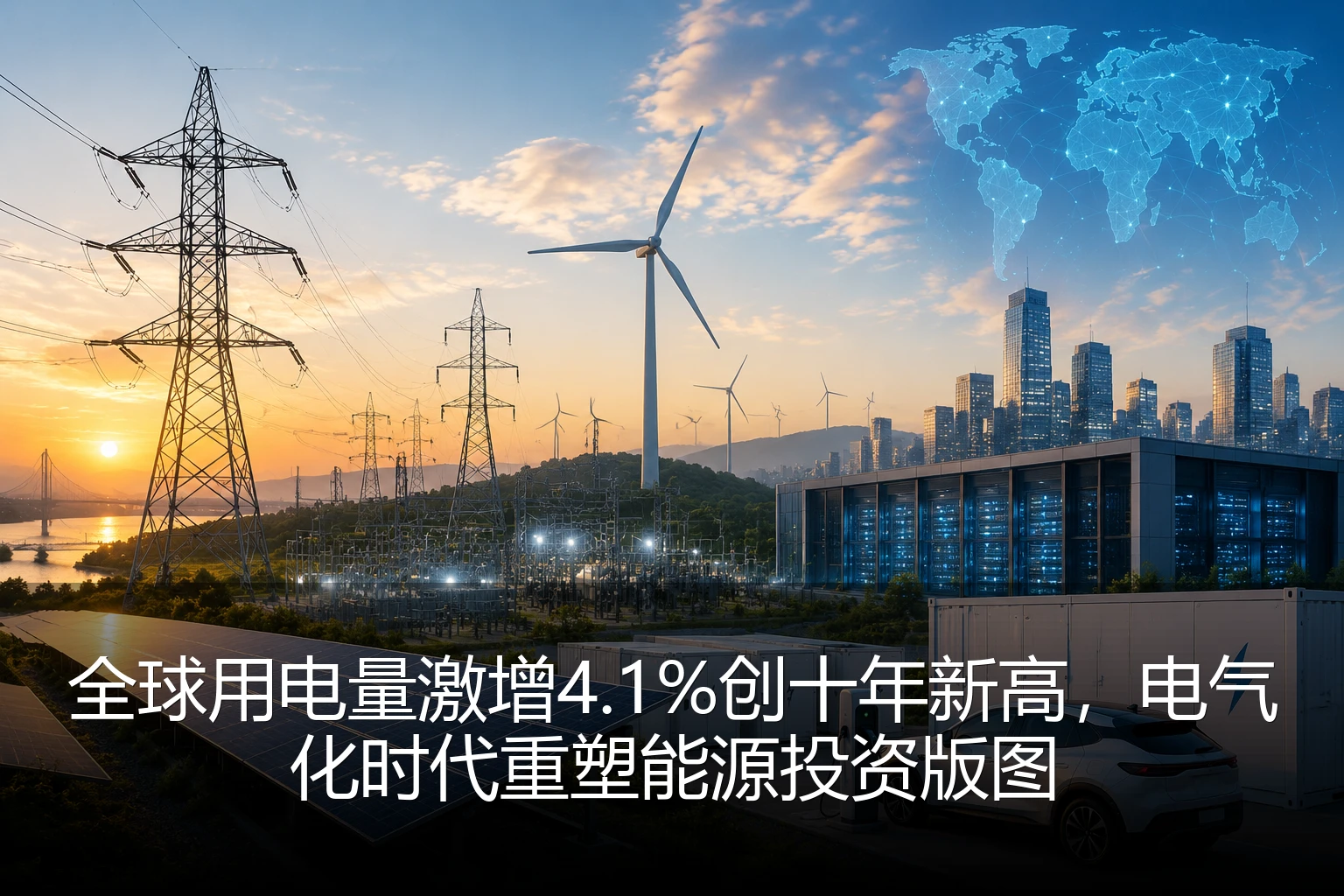
The International Energy Agency (IEA) released its "Global Electricity Market Mid-Year Assessment Report" on July 30, showing that global electricity demand grew by 4.1% year-on-year in the first half of 2026, marking the fastest growth rate in nearly a decade. The report predicts that with the continued expansion of electric vehicles, data centers, and air conditioning demand, the average annual growth rate of global electricity demand from 2026 to 2028 will remain around 3.8%, far exceeding the growth rate of primary energy consumption during the same period.
Three Drivers of Electricity Demand Growth: Electric Vehicles, Data Centers, and Air Conditioning
The IEA report points out that the growth in global electricity demand is mainly driven by three factors. First, electric vehicle sales continued to climb in 2026, with the global EV fleet exceeding 200 million units in the first half, making charging demand a new growth point for electricity consumption. Second, the artificial intelligence and big data industries are accelerating expansion, with global data center electricity consumption surging 23% year-on-year in the first half of 2026, accounting for over 4% of total global electricity consumption for the first time. Additionally, affected by extreme high temperatures, global air conditioning ownership and operating hours continue to increase, with summer peak electricity loads repeatedly hitting new highs.
Notably, the growth in electricity demand shows a clear "East rising, West declining" pattern. China and India, the two major emerging markets, contributed 65% of the global increase in electricity demand. Among them, China's total social electricity consumption grew by 6.3% year-on-year in the first half, driven by manufacturing and new infrastructure; India's electricity consumption increased by 5.8%, with residential and agricultural electricity demand continuing to rise. In contrast, electricity consumption in Europe and Japan remained basically stable, reflecting the impact of economic structural transformation and energy efficiency improvements.
Renewable energy generation share reaches new high, but power systems face challenges
Along with the high growth in electricity demand, the clean energy transition of the power structure is also accelerating. IEA data shows that in the first half of 2026, global renewable energy generation increased by 11% year-on-year, accounting for 38% of total global electricity generation, with solar power generation accounting for more than half of the new renewable energy additions. Wind power, hydropower, and biomass power generation also maintained steady growth.
However, the IEA also warns that the rapid growth in electricity demand is putting pressure on grid security and power supply. Some countries are facing issues such as insufficient reserve capacity, grid congestion, and increasing electricity price volatility. For example, in June 2026, the southwestern United States experienced extreme high temperatures, with electricity spot prices soaring to $300 per megawatt-hour at one point, forcing grid operators to initiate emergency demand response. Similar tensions have also appeared in some parts of India and Southeast Asia.
Global grid investment urgently needs to accelerate, energy storage becomes "essential"
The report points out that to achieve safe and stable operation of the global power system, global grid infrastructure investment from 2026 to 2030 needs to reach an average of $500 billion annually, more than double the current investment level. At the same time, energy storage installed capacity needs to grow at an annual rate of over 15% to cope with the intermittent challenges of renewable energy.
In the field of energy investment and financing, the power sector is becoming a focus of capital pursuit. From upstream power generation equipment to midstream grid operations, to downstream charging facilities and energy storage systems, all links in the industrial chain show strong investment demand. Especially in niche areas such as grid digitalization, smart dispatching, and high-voltage direct current transmission, they are considered key technologies to fill the power gap.
Global Energy Watch: Electricity demand is a "barometer" of energy transition
From the perspective of "Global Energy Watch," changes in electricity demand are the most direct indicator of observing the alternation between old and new energy. Traditionally, the energy system dominated by oil and coal is gradually giving way to a new energy system with electricity as the core. The global electrification rate (the proportion of electricity in final energy consumption) exceeded 25% for the first time in the first half of 2026, an increase of 6 percentage points compared to ten years ago. This trend indicates that future energy investment logic will focus more on the two main lines of "power infrastructure" and "clean power generation."
The IEA's Chief Economist said at the press conference: "The success of the global energy transition depends largely on whether we can build a stronger and smarter power system. Electricity is not only the end point of energy, but also the carrier for renewable energy development. In the next three years, the growth momentum of global electricity demand will not weaken, and policymakers and investors need to be prepared to embrace a new era of electrification."
For energy practitioners and investors, electricity consumption data has become a key indicator to grasp the pulse of the energy market. Continuously monitoring changes in electricity consumption, power generation structure transformation, and grid investment dynamics in major global economies will help capture opportunities in the wave of energy transformation.
