


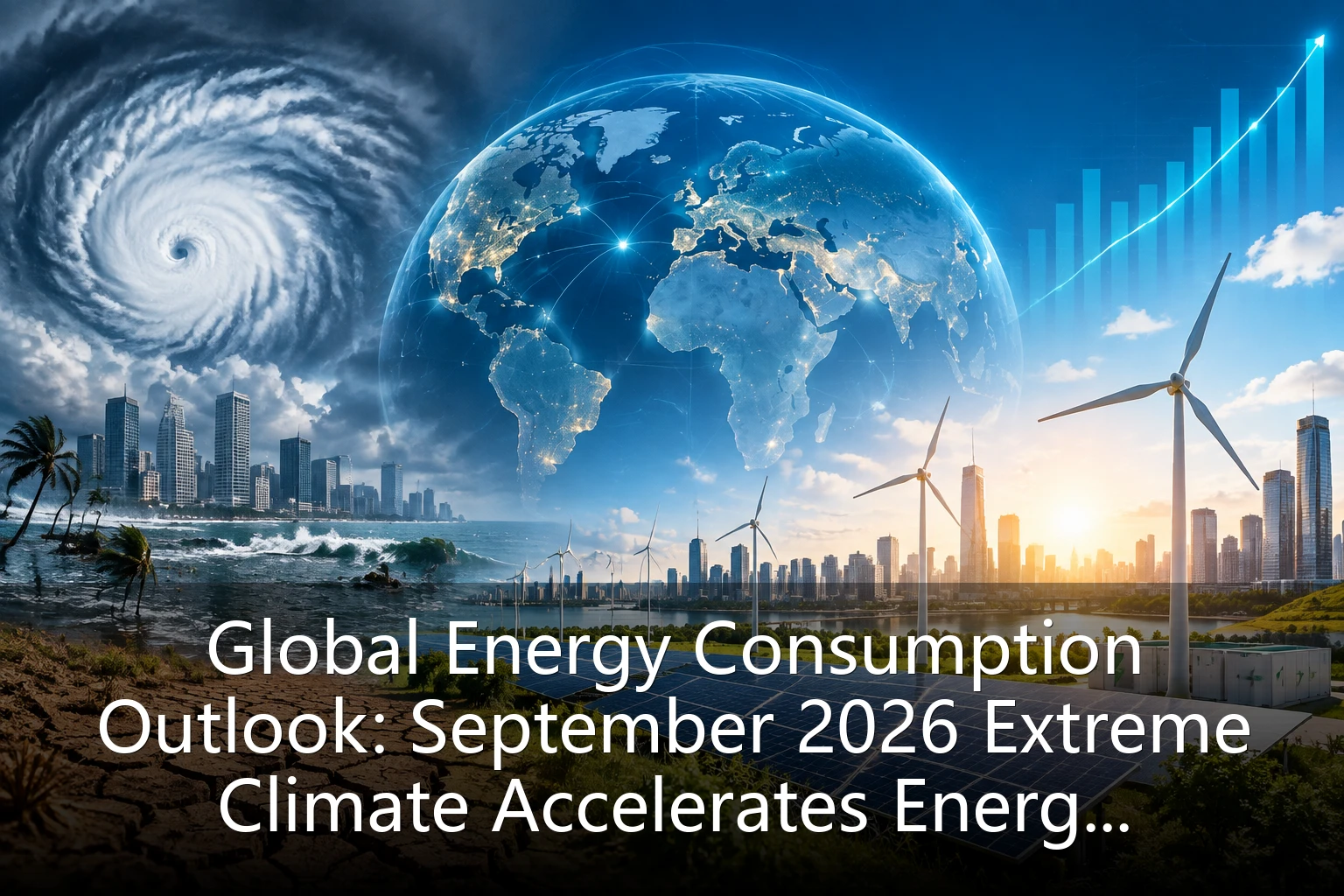
September 2026, the global energy consumption pattern is undergoing unprecedented profound changes. The frequent occurrence of extreme climate events and breakthrough progress in renewable energy technology are reshaping the global energy landscape, pushing the energy transition into an accelerated period. This article will start from global energy consumption data, analyze current energy consumption trends, interpret how extreme climate and renewable energy jointly promote energy system transformation, and provide investors with precise gold-digging routes for the energy dividend period.
\n\nGlobal Energy Consumption Overall Trends: Slowing Growth and Structural Optimization
\n\nAccording to the latest global energy consumption data, in the first three quarters of 2026, global primary energy consumption increased by approximately 1.8% year-on-year, a decrease of 0.7 percentage points compared to the same period last year. This data indicates that although the global economy is still growing, the growth rate of energy consumption has entered a relatively stable period, reflecting the dual effects of improved energy efficiency and structural optimization.
\n\nIn terms of energy structure, the proportion of renewable energy continues to climb, reaching 35% of global primary energy consumption, an increase of 3 percentage points compared to the same period in 2025. Among them, solar and wind energy contributed 70% of the renewable energy increment, becoming the main force of energy transition. At the same time, the proportion of fossil fuels continues to decline, with coal's share in primary energy consumption falling below 25%, the lowest level in history.
\n\nIt is worth noting that the regional pattern of energy consumption is undergoing significant changes. The Asia-Pacific region continues to maintain its position as the world's largest energy consumption area, accounting for 42% of global energy consumption, of which non-OECD countries contributed 85% of the energy consumption increment in the Asia-Pacific region. Europe and North America account for 22% and 18% of total energy consumption respectively, while Africa and the Middle East account for 6% and 12% respectively.
\n\nExtreme Climate: A "Double-edged Sword" for Energy Consumption
\n\nIn the summer of 2026, many parts of the world experienced extreme high temperatures, with temperatures in many parts of the Northern Hemisphere breaking historical records. According to data from the International Energy Agency (IEA), extreme heat led to a 15% year-on-year increase in global air conditioning electricity demand, becoming one of the main factors driving electricity consumption growth. At the same time, drought weather led to a decrease in hydropower output, and some areas had to increase gas power generation, thereby increasing energy consumption costs.
\n\nHowever, extreme climate has also accelerated the pace of global energy transition. In Europe, continuous high temperatures have prompted countries to accelerate the deployment of renewable energy, especially solar photovoltaic installation capacity set a monthly new record in summer. In Asia, extreme weather events such as typhoons have prompted countries to strengthen the resilience of energy infrastructure, promoting the development of distributed energy and microgrids.
\n\nThe impact of climate change on energy consumption shows obvious regional differences. In high-latitude areas such as Northern Europe, rising winter temperatures have led to decreased heating demand and increased cooling demand; while in Southern Europe, the Middle East and other regions, continuous high temperatures have led to a significant increase in cooling demand, with significant energy consumption pressure.
\n\nRenewable Energy: The Core Driving Force of Energy Transition
\n\nIn the first three quarters of 2026, global renewable energy installed capacity increased by 12% year-on-year, with new installed capacity exceeding 350GW. Among them, solar photovoltaic new installed capacity was about 200GW, wind power new installed capacity was about 120GW, and other renewable energy such as biomass, geothermal and small hydropower new installed capacity was about 30GW. Renewable energy has become the dominant force in global new installed capacity.
\n\nTechnological progress is the key factor in the rapid development of renewable energy. The efficiency of solar photovoltaic modules continues to improve, with the conversion efficiency of mainstream products exceeding 22%, an increase of about 5 percentage points compared to 2020. At the same time, photovoltaic manufacturing costs continue to decrease, and the current levelized cost of electricity (LCOE) of photovoltaic power generation has fallen below that of most new fossil fuel power generation projects.
\n\nIn terms of policy support, governments continue to increase support for renewable energy. The EU raised its 2030 renewable energy target to 45% through the "REPowerEU" plan; the US "Inflation Reduction Act" extended and expanded renewable energy tax credit policies; China launched the "14th Five-Year" energy plan, clarifying the goal of reaching 1.2 billion kilowatts of renewable energy installed capacity by 2025.
\n\nEnergy Storage Technology: The "Stabilizer" of Renewable Energy
\n\nAs the proportion of renewable energy increases, the importance of energy storage systems is increasingly prominent. In the first three quarters of 2026, global energy storage installed capacity increased by 40% year-on-year, with new installed capacity exceeding 50GW. Among them, electrochemical energy storage (mainly lithium batteries) accounts for about 65%, pumped storage accounts for about 30%, and other energy storage technologies account for about 5%.
\n\nLong-duration energy storage technology has made breakthrough progress. The commercialization process of long-duration energy storage technologies such as flow batteries, compressed air energy storage, and flywheel energy storage is accelerating, solving the intermittency and volatility problems of renewable energy. It is predicted that by 2030, the proportion of long-duration energy storage in global installed energy storage will increase to 25%.
\n\nEnergy storage costs continue to decrease, and economic efficiency continues to improve. The cost of lithium battery energy storage systems has decreased by about 40% compared to 2020, making energy storage projects commercially feasible in more regions. At the same time, the combination model of energy storage and renewable energy continues to innovate, such as "photovoltaic + energy storage" and "wind power + energy storage" integrated projects have become mainstream development models.
\n\nComparison of Energy Transition in Major Economies
\n\nEurope: The Pioneer of Energy Transition
\n\nEurope continues to lead the global energy transition process. In the first three quarters of 2026, the proportion of renewable energy in primary energy consumption in the EU reached 22%, an increase of 2 percentage points compared to the same period in 2025. Germany, Spain and the UK are the leaders in renewable energy development in Europe, and the three countries' renewable energy installed capacity accounts for 45% of the EU's total.
\n\nThe main challenge facing Europe's energy transition is the balance between energy security and renewable energy development. After the Russia-Ukraine conflict, Europe accelerated its energy independence strategy, vigorously developing local renewable energy while strengthening energy interconnection. Europe is also actively promoting green hydrogen development, planning to build 40GW of electrolytic hydrogen production capacity by 2030.
\n\nAsia-Pacific: The Main Engine of Energy Consumption Growth
\n\nThe Asia-Pacific region is the main source of global energy consumption growth and is also an active area of energy transition. China continues to maintain its position as the world's largest country in renewable energy installed capacity, with a year-on-year increase of 15% in renewable energy installed capacity in the first three quarters of 2026. India's renewable energy installed capacity growth rate exceeds 20%, becoming one of the fastest growing renewable energy markets in the world.
\n\nThe energy transition in the Asia-Pacific region shows obvious differentiation. Developed economies such as Japan and South Korea focus on the development of hydrogen energy and nuclear energy, while Southeast Asian countries focus on the development of solar energy and hydropower. While comprehensively promoting energy transition, China also pays attention to the coordinated development of traditional energy and renewable energy to ensure energy supply security.
\n\nAmericas: Parallel Development of Traditional Energy and Renewable Energy
\n\nThe energy transition in the Americas region shows diversified characteristics. The renewable energy installed capacity in the United States continues to grow, with new installed capacity exceeding 30GW in the first three quarters of 2026, of which solar photovoltaics account for about 60%. Canada relies on its rich hydropower and wind energy resources, and the proportion of renewable energy in primary energy consumption has exceeded 65%.
\n\nLatin America has rich renewable energy resources, and countries such as Brazil, Mexico and Chile are actively promoting energy transition. Brazil's hydropower accounts for more than 60%, and its biomass energy utilization is also at the world's leading level. Mexico and Chile focus on the development of solar energy and wind energy, and the growth rate of renewable energy installed capacity in both countries exceeds 25%.
\n\nEnergy Dividend Period: Investment Opportunities and Challenges
\n\nInvestment Hotspots
\n\nEnergy transition is creating huge investment opportunities. In the first three quarters of 2026, global energy transition investment exceeded 800 billion US dollars, a year-on-year increase of 15%. Among them, renewable energy accounts for about 60% of investment, grid upgrading accounts for about 20%, energy efficiency improvement accounts for about 15%, and emerging technologies such as hydrogen energy account for about 5%.
\n\nThe renewable energy sector is still an investment hotspot. All links of the solar photovoltaic industry chain have received a large amount of investment, especially in the field of high-efficiency battery and component manufacturing. Wind power investment is shifting to emerging fields such as offshore wind power and floating wind power. At the same time, energy storage system investment is growing rapidly, especially grid-level energy storage and industrial and commercial energy storage projects.
\n\nGrid upgrading and transformation is the basic support of energy transition. With the increase in the proportion of renewable energy, the demand for grid intelligence and flexibility transformation has surged. Smart grids, microgrids, virtual power plants and other technologies have become investment hotspots. It is predicted that by 2030, the cumulative global grid upgrading and transformation investment will exceed 2 trillion US dollars.
\n\nInvestment Risks and Challenges
\n\nEnergy transition investment faces multiple challenges. Policy risk is one of the main risks, as countries frequently adjust energy policies, which may lead to investment returns not meeting expectations. Technical risks cannot be ignored either. Some emerging technologies are still in the initial stage of commercialization, and there is a risk of improper technology route selection.
\n\nMarket risk is also worthy of attention. The continuous decline in renewable energy generation costs may lead to a decline in the return rate of some projects. At the same time, imperfect electricity market mechanisms also increase investment uncertainty. In addition, factors such as supply chain risks and rising financing costs also pose challenges to energy transition investment.
\n\nFuture Energy Development Forecast
\n\nLooking ahead, the global energy transition will enter an accelerated period. According to the International Energy Agency's forecast, by 2030, the proportion of renewable energy in global primary energy consumption will exceed 40%, becoming the dominant energy form. Solar energy and wind energy will become the fastest growing energy types, with an average annual growth rate expected to exceed 8%.
\n\nThe energy consumption structure will be further optimized. By 2030, the proportion of fossil fuels in primary energy consumption will fall below 60%, and the proportion of coal will further decrease to below 20%. As a transitional energy, natural gas will maintain a relatively stable proportion and play an important role in the flexibility of the power system.
\n\nThe energy system will develop in the direction of intelligence and digitalization. Artificial intelligence, big data, Internet of Things and other technologies will be deeply integrated with the energy system, promoting the digital transformation of the entire chain of energy production, transmission and consumption. New energy systems such as virtual power plants and energy Internet will accelerate development, improving energy system efficiency and flexibility.
\n\nGold-digging Routes in the Energy Dividend Period
\n\nFor investors, the energy dividend period provides diversified investment opportunities. From the perspective of the industrial chain, renewable energy equipment manufacturing, energy storage systems, smart grids and other links have greater investment value. From a regional perspective, emerging markets such as Asia-Pacific, Africa and Latin America will provide more investment opportunities.
\n\nInvestment strategies should focus on long-term and diversified. Energy transition is a long-term process, and investors should adopt a long-term investment perspective, focusing on technological progress and cost reduction trends. At the same time, a diversified investment portfolio should be constructed to balance risks and returns, and grasp investment opportunities in different technology routes and regional markets.
\n\nPolicy orientation is an important reference for investment decisions. Investors should pay close attention to changes in national energy policies and grasp the key areas and directions of policy support. At the same time, attention should be paid to the social impact of the energy transition process, such as changes in employment, energy equity and other issues, to achieve a balance between economic and social benefits.
\n\nIn conclusion, in September 2026, the global energy consumption pattern is undergoing profound changes, with extreme climate and renewable energy development jointly promoting the acceleration of energy transition. The energy dividend period provides broad opportunities for investors, but it is also accompanied by many challenges. Only by accurately grasping the trend of energy transition and rationally analyzing investment value can we achieve sustainable development in the energy dividend period.
