


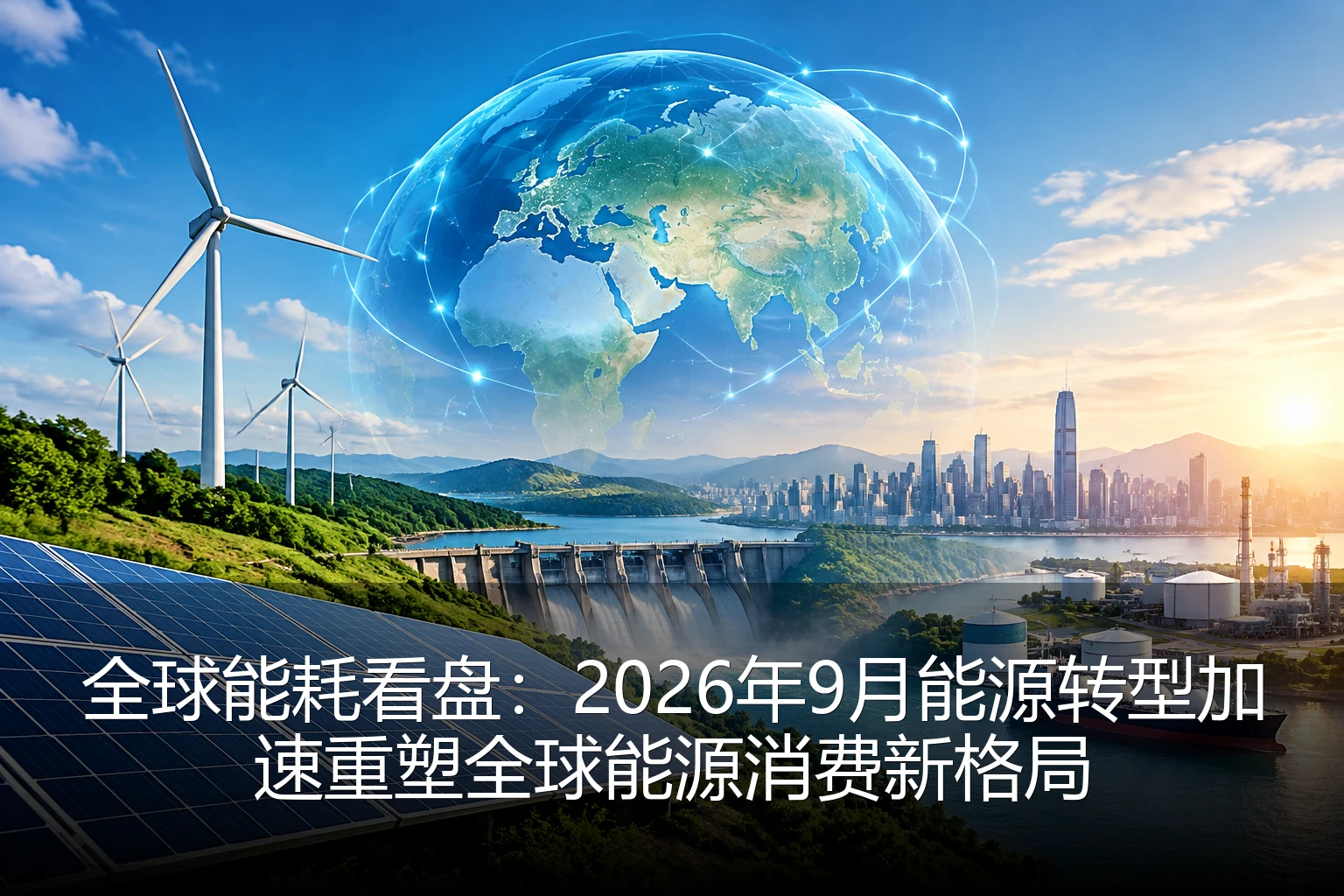
Global Energy Consumption Outlook: Energy Transition Accelerates and Reshapes the New Global Energy Consumption Landscape
In September 2026, the global energy transition is entering an unprecedented acceleration phase, reshaping the global energy landscape. According to the latest global energy consumption data, the share of renewable energy will exceed 40% for the first time, while the share of traditional energy continues to decline, and energy efficiency is significantly improving. This transition not only changes how energy is produced and consumed but also profoundly impacts global energy security, economic development, and geopolitical structures.
Overall Trends in Global Energy Transition Acceleration
The global energy transition in 2026 shows an unprecedented acceleration. According to the latest report from the International Energy Agency's 'Global Energy Transition Report,' in the first half of 2026, new installed renewable capacity reached a record 350GW, a year-on-year increase of 35%. Solar photovoltaic and wind power contributed 180GW and 120GW of new capacity, respectively, while hydropower and biomass contributed 25GW each.
At the same time, the structure of global energy consumption is also changing significantly. Data shows that in the first half of 2026, total global energy consumption was 58 billion tons of standard coal, a year-on-year increase of 1.8%, slowing down by 0.7 percentage points compared to the same period last year. The share of renewable energy consumption reached 38.5%, an increase of 3.2 percentage points compared to 2025; coal consumption share dropped to 25.3%, while oil and natural gas accounted for 31.2% and 24.8% respectively.
Improvements in energy efficiency are a key driver of the energy transition. In the first half of 2026, energy consumption per unit of GDP decreased by 3.5% year-on-year, mainly due to the widespread adoption of industrial energy-saving technologies, improvements in building energy efficiency, and the acceleration of electrification in transport. This trend indicates that the world is gradually moving away from high-energy consumption growth models toward high-quality development.
Regional Differences in Energy Source Transition
The global energy transition shows clear regional differences; different countries and regions adopt differentiated transition paths based on their resource endowments, development stage, and policy orientation.
Europe, as a pioneer in energy transition, saw a renewable energy generation share of 48% in the first half of 2026, with renewable energy generation exceeding 60% in countries like Germany, Denmark, and the UK. The core of Europe's energy transition is phasing out dependence on Russian energy while achieving carbon neutrality goals. The full implementation of the EU's "Fit for 55" package has promoted the enforcement of carbon border adjustment mechanisms, renewable energy directives, and energy efficiency standards.
In the North American region, especially the United States, under the incentives of the Inflation Reduction Act, renewable energy installed capacity grew by 28% year-on-year in the first half of 2026, with solar photovoltaic growth being the most significant. The characteristic of US energy transition is the synergy between federal and state policies, combining market mechanisms with government subsidies to reduce energy costs and promote job growth.
The Asia-Pacific region is the main force in the global energy transition. In the first half of 2026, the Asia-Pacific region accounted for 60% of the total global new renewable energy installed capacity, with China contributing 45% of the new capacity. India, Japan, and South Korea are also accelerating their energy transition, but face dual challenges of energy security and low-carbon transition. Notably, Southeast Asian countries like Vietnam, Thailand, and Malaysia are becoming hotspots for new energy investment, attracting large amounts of international capital.
Although Africa and the Middle East are starting later in the global energy transition, they show huge potential. In the first half of 2026, new renewable energy installed capacity in Africa grew by 45% year-on-year, mainly distributed in South Africa, Egypt, and Morocco. Middle Eastern countries like Saudi Arabia and the UAE are leveraging abundant solar resources to actively develop green hydrogen industries and promote energy export diversification.
The Impact of Technological Progress on Energy Transition
Technological innovation is a key force driving the energy transition.
Breakthroughs in various energy technologies significantly accelerated the global energy transition process in 2026.
In the energy storage technology field, global energy storage capacity first surpassed 200GW, reaching 215GW, a year-on-year increase of 65%. New energy storage technologies such as long-duration storage, compressed air storage, and gravity storage are accelerating their commercialization process. These technologies effectively solve the intermittency and volatility problems of renewable energy, improving grid stability.
In smart grid technology, global smart grid investment reached $120 billion in 2026, a year-on-year increase of 40%. The application of technologies such as digital twins, AI forecasting, and edge computing makes grid operation more intelligent and efficient. Smart grid coverage in Europe and North America exceeds 80%, and is rapidly advancing in the Asia-Pacific region.
In energy digitalization management, the application of blockchain technology, IoT, and big data analytics in the energy sector is increasingly widespread. The market size for global energy digitalization management reached $35 billion in the first half of 2026, a year-on-year increase of 45%. These technologies not only improve energy utilization efficiency but also foster new energy business models and service forms.
Hydrogen energy technology as an important support for the energy transition, saw global hydrogen industry investment reach $80 billion in 2026, a year-on-year increase of 55%. Green hydrogen costs have dropped below $3 per kilogram, approaching the cost of producing hydrogen from fossil fuels. The application of hydrogen is accelerating in areas such as heavy industry, long-distance transport, and seasonal energy storage.
Dual Drivers of Policy and Market Mechanisms
The dual drivers of policy frameworks and market mechanisms provide powerful momentum for the global energy transition.
Carbon pricing mechanisms are being promoted globally. In 2026, the volume of greenhouse gas emissions covered by the global carbon market reached 40 billion tons, accounting for 35% of total global emissions, an increase of 8 percentage points from 2025. The full implementation of the EU's Carbon Border Adjustment Mechanism is prompting more countries and regions to establish carbon pricing systems, pushing the global carbon price to an average of 50 Euros/ton.
Support for renewable energy policies is continuously strengthening. In the first half of 2026, the total amount of global renewable energy subsidies reached $280 billion, a year-on-year increase of 25%. China, the US, and the EU continue to hold the top three spots for renewable energy subsidies, and subsidy levels for developing countries like India, Brazil, and South Africa are also significantly increasing. The focus of subsidies is shifting from installed capacity to grid integration and system flexibility, promoting high-quality development of renewable energy.
Energy transition funds are becoming important tools for mobilizing investment. In 2026, the scale of global energy transition funds reached $12 trillion, a year-on-year increase of 45%. These funds reduce investment risks for renewable energy projects through blended financing, risk sharing, and credit enhancement, attracting more private capital into the energy transition sector.
Innovation in market mechanisms is also accelerating the energy transition process. In 2026, the market size for global renewable energy certificate trading reached $80 billion, a year-on-year increase of 60%. Market mechanisms such as virtual power plants, demand response, and power auxiliary services are maturing, improving the flexibility and efficiency of power systems.
The Impact of Energy Transition on Global Energy Consumption Pattern
Energy transition is profoundly reshaping the global energy consumption pattern, affecting multiple dimensions including energy structure, energy flows, consumption patterns, and geopolitics.
In terms of energy structure, the share of renewable energy continues to increase while the share of traditional energy steadily declines. In the first half of 2026, the share of renewable energy in the global electricity structure reached 43%, an increase of 4 percentage points compared to 2025. The share of fossil fuel power generation dropped to 55%, with coal-electricity generation dropping to 28%, and natural gas generation stable at 27%. This change resulted in a 5.8% year-on-year decrease in carbon emissions intensity in the power system.
In terms of energy flows, the traditional energy trade pattern is being reshaped. In the first half of 2026, coal and fuel trade volume decreased by 12% year-on-year, oil trade growth slowed to 2%, and natural gas trade grew by 5%. Meanwhile, trade in renewable energy equipment and technology grew rapidly, with the global trade value of renewable energy equipment reaching $250 billion, a year-on-year increase of 35%. China, Germany, and the US are the top three exporters of renewable energy equipment.
In terms of energy consumption patterns, the rate of end-use electrification continues to rise. In the first half of 2026, the global end-use electrification rate reached 24%, an increase of 1.5 percentage points compared to 2025. The electrification process in transport, buildings, and industry is accelerating; electric vehicle ownership exceeded 150 million vehicles, building electrification reached 35%, and industrial electrification reached 22%. This change significantly improves energy utilization efficiency and reduces energy consumption per unit of GDP.
In terms of geopolitics, energy transition is reshaping the global energy map. Traditional energy exporting countries such as Russia, Saudi Arabia, and the UAE are accelerating energy diversification strategies, increasing investment in renewable energy and clean technologies. Energy importing countries such as the EU, Japan, and South Korea are reducing energy dependence by developing domestic renewable energy and energy diversity. This change is altering the traditional energy geopolitical landscape, forming new relationships of energy cooperation and competition.
Future Outlook and Investment Opportunities
Looking ahead, the global energy transition will continue to accelerate, bringing unprecedented opportunities and challenges for energy practitioners and investors.
From development trends, the global energy transition will have the following characteristics before 2030: the share of renewable energy will exceed 50%, energy efficiency will increase cumulatively by 25%, the end-use electrification rate will reach 35%, the hydrogen industry scale will surpass $500 billion, and the carbon market will cover 50% of global greenhouse gas emissions. These trends will create huge market space for energy transition-related industries.
Investment opportunities are mainly concentrated in the following areas:
- Renewable Energy Development: Renewable energy projects such as solar, wind, hydropower, and biomass still have investment value, especially distributed energy and microgrid projects.
- Energy Storage Technology: The markets for long-duration storage, grid-scale storage, and user-side storage will grow rapidly, with the global energy storage market size expected to reach $500 billion by 2030.
- Smart Grids: The application of technologies such as digital twins, AI, and edge computing in the grid will create huge investment opportunities; demand for smart grid renovation and upgrades is strong.
- Hydrogen Chain: The entire hydrogen chain—production, transport, and application—will see explosive growth, especially in hydrogen applications for heavy industry and long-distance transport.
- Energy Digitalization: The application of blockchain, IoT, and big data analytics in the energy sector will create new business models and service forms, with broad prospects for the energy digitalization management market.
- Carbon Market and Green Finance: Carbon credit trading, carbon financial products, and green bonds will develop rapidly, providing financial support for energy transition.
However, energy transition also faces many challenges, including technological bottlenecks, policy uncertainty, imperfect market mechanisms, financing gaps, and geopolitical risks. Energy practitioners and investors need to closely monitor these challenges, develop flexible coping strategies, and seize the opportunities brought by energy transition.
Conclusion
In September 2026, the global energy transition is entering an acceleration phase, reshaping the global energy consumption pattern. The share of renewable energy continues to increase, energy efficiency is significantly improving, and the process of end-use electrification is accelerating. These changes not only alter how energy is produced and consumed but also have profound impacts on the global economy, society, and environment.
Energy transition is a systemic change requiring technological innovation, policy support, market mechanisms, and multi-party cooperation. Facing climate change challenges and energy security needs, the global energy transition will continue to accelerate, creating new opportunities for energy practitioners and investors.
The next decade will be a critical period for energy transition. Energy practitioners and investors need to grasp the trends, cope with challenges, and seize opportunities to achieve sustainable development in the wave of energy transition. Gu Pin Energy Island will continue to monitor global energy transition dynamics, providing professional market references for energy practitioners and investors to help grasp investment opportunities brought by the energy boom.
