


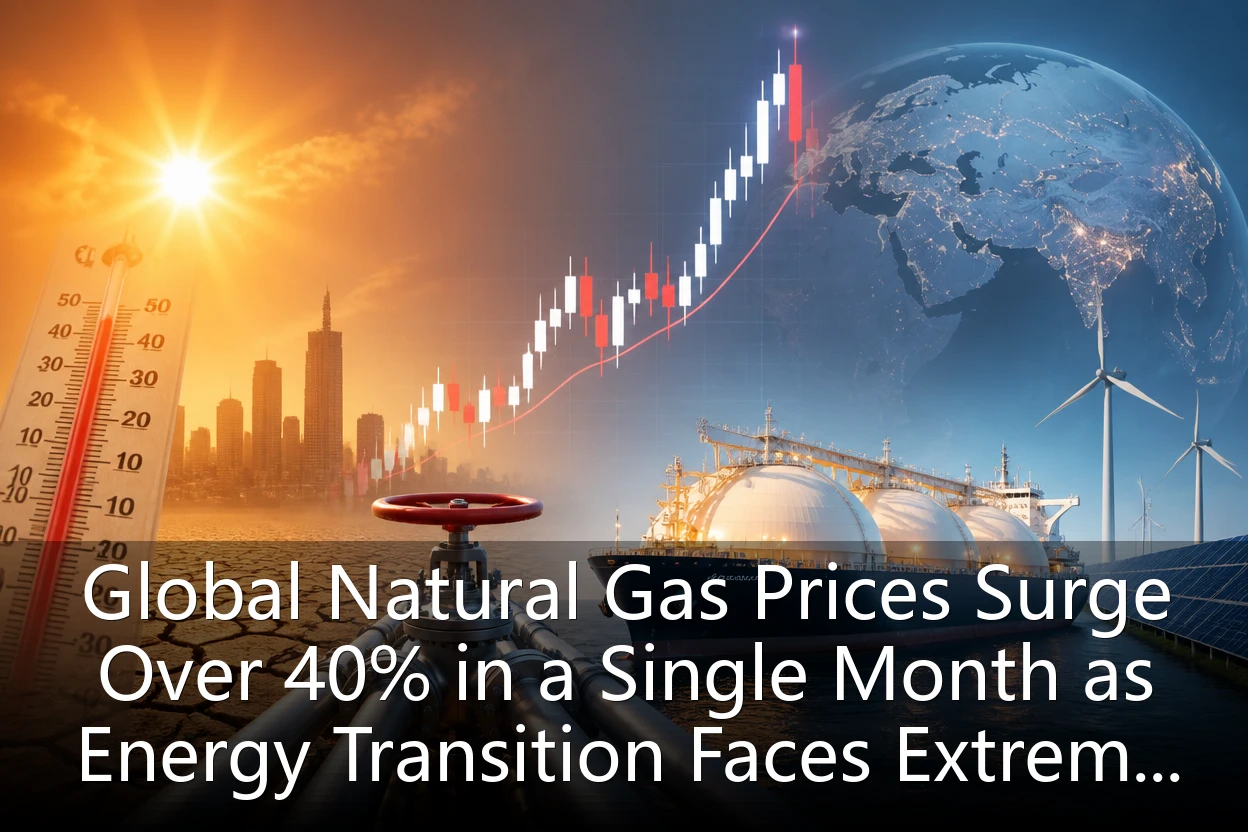
Energy Alarm Under Scorching Heat: Natural Gas Prices Surge 28% in a Month
From July to early August 2026, global energy markets underwent a sudden stress test. Driven by persistent extreme heat across the Northern Hemisphere, lower-than-expected renewable energy output, and geopolitical disruptions, international natural gas prices experienced a steep climb. The European TTF benchmark price surged over 40% in July, briefly exceeding 55 euros per megawatt-hour, reaching an 18-month high. Meanwhile, Asian spot LNG prices also rose, with the JKM price index climbing about 28% in a single month, approaching the $16 per million British thermal units mark.
This sharp price spike shattered the earlier market consensus that energy prices would continue their moderate decline. Previously, due to a mild winter in 2025, ample European gas storage, and slowing global economic growth, market institutions widely predicted that natural gas prices would remain low and volatile in 2026. However, starting in July, many parts of the Northern Hemisphere experienced historic heatwaves, causing a surge in cooling electricity demand. Natural gas-fired power generation load increased significantly, and storage depletion far exceeded expectations, rapidly reversing market sentiment.
Multiple Factors Converge: Extreme Climate, Supply Elasticity, and Geopolitical Risks
This round of natural gas price increases was not driven by a single factor but by the convergence of multiple pressures. First, extreme heat was the direct trigger. Since July, Southern Europe, Western North America, and East Asia experienced persistent high temperatures, with many areas exceeding 40 degrees Celsius. Electricity demand, driven by cooling loads, hit historical peaks, and natural gas, as the primary fuel for peak-shaving power generation, saw a pulse-like surge in consumption. According to preliminary estimates by the International Energy Agency (IEA), global gas-fired power generation increased by approximately 8.5% year-on-year in July, far exceeding the average growth rate in the first half of the year.
Second, the instability of renewable energy output under extreme weather was once again exposed. European wind power output declined significantly in mid-to-late July, with utilization rates in some areas dropping below 10%, far lower than the typical 20% to 25% for the same period. Although solar power performed well during the day, natural gas generation was still needed to fill the gap during evening and peak night hours. This pattern of fluctuating renewable output backed up by natural gas continuously depleted gas inventories over weeks of sustained heat.
Third, geopolitical factors once again disrupted supply-side expectations. New tensions emerged in the Middle East in mid-July, increasing transit risks through the Strait of Hormuz and raising insurance costs for LNG shipping routes, further pushing up the Asian spot premium. Additionally, short-term outages at LNG export terminals on the U.S. Gulf Coast due to equipment maintenance tightened global supply.
The 'Cost Stress Test' for Old and New Energy: Reassessing the Backup Value of Fossil Fuels
This sharp rise in natural gas prices profoundly reveals a key contradiction in the current energy transition phase: although renewable energy capacity continues to expand, the backup role of traditional fossil fuels remains irreplaceable in the face of extreme climate and output fluctuations. Europe has vigorously promoted energy transition in recent years, accelerating the phase-out of coal power and slowly restarting nuclear power, making natural gas generation the core pillar of power system flexibility. However, when natural gas prices soar, electricity costs and inflationary pressures also rise, making the 'cost of green transition' explicit.
From an investment perspective, this event is reshaping the market's pricing logic for old and new energy assets. In the first half of 2026, global renewable energy capacity exceeded 1.6 billion kilowatts, with solar and wind costs continuing to decline. Some markets even experienced 'negative electricity prices,' leading the market to believe that fossil fuel assets would depreciate faster. However, the July gas price spike reminded investors that energy system resilience cannot be measured by capacity alone; the value of peak-shaving and backup capacity is repriced under extreme scenarios. Shares of major European gas-fired power generators and LNG importers generally rose in July, with some energy giants hitting new highs for the year, reflecting the market's renewed recognition of an 'energy security premium.'
Structural Changes in Global Energy Markets: Rising Asian Demand and Tightening Carbon Constraints
Notably, the role of the Asian market is undergoing a structural shift in this round of natural gas price increases. Natural gas demand in China, India, and Southeast Asian countries rose significantly during the hot weather, narrowing the spread between Asian spot LNG prices and European prices to a historical low, reflecting the evolution of the global gas market from 'Eurocentric' to 'multipolar.' China, the world's largest LNG importer, saw its July imports increase by about 12% year-on-year, partly due to increased domestic gas-fired power capacity and recovering industrial gas demand. This trend means that Asian demand will exert greater influence on global natural gas pricing in the future.
Meanwhile, the linkage between carbon markets and natural gas prices is strengthening. European carbon allowance prices rose simultaneously in July, breaking through 100 euros per ton, further raising the threshold for the cost advantage of gas-fired power over coal-fired power. Against the backdrop of high carbon prices, the economic viability of natural gas generation has marginally improved, but rising absolute costs still pressure end-users. The EU is considering launching a new round of energy price regulation mechanisms to balance carbon reduction goals with living costs.
Investment Insights: Energy Transition Enters the Era of 'Resilience Premium'
For energy investors and practitioners, this round of natural gas price volatility offers several important insights. First, energy system 'resilience' is becoming a new valuation dimension. Simply pursuing renewable energy capacity growth is no longer sufficient to ensure system security; the investment value of supporting facilities such as energy storage, peak-shaving power sources, and cross-regional transmission will further increase. Second, the role of natural gas as a transition fuel is unlikely to be replaced in the short term, but against the backdrop of tightening carbon constraints, its investment logic needs to be comprehensively assessed in conjunction with carbon prices. Third, the increasing frequency of extreme climate events is becoming the new normal for energy markets, requiring energy investment portfolios to incorporate climate risk factors and rationally allocate traditional and new energy assets to cope with price volatility risks.
Looking ahead to the remainder of 2026, the trajectory of natural gas markets will depend on the interplay of multiple variables: the duration of hot weather, the pace of European storage replenishment, the recovery of global LNG supply, and the evolution of geopolitical situations. In a report released at the end of July, the International Energy Agency noted that the global natural gas market will remain in a tight balance in the second half of 2026, with price volatility likely to remain elevated. For China, under the dual constraints of energy security and 'dual carbon' goals, the importance of natural gas as a transitional role in 'reducing coal and increasing gas' and its strategic reserves and price stabilization mechanisms is further highlighted.
Overall, the natural gas price surge in July 2026 is not a simple market fluctuation but a 'cost stress test' for the old and new energy systems under climate pressure. It reminds all market participants that the energy transition is not a straight line but a complex process of finding balance amid volatility. As the marginal cost of renewable energy approaches zero, the value of system resilience will rise, and the 'backup premium' of traditional energy will be rediscovered by the market under extreme conditions.
