


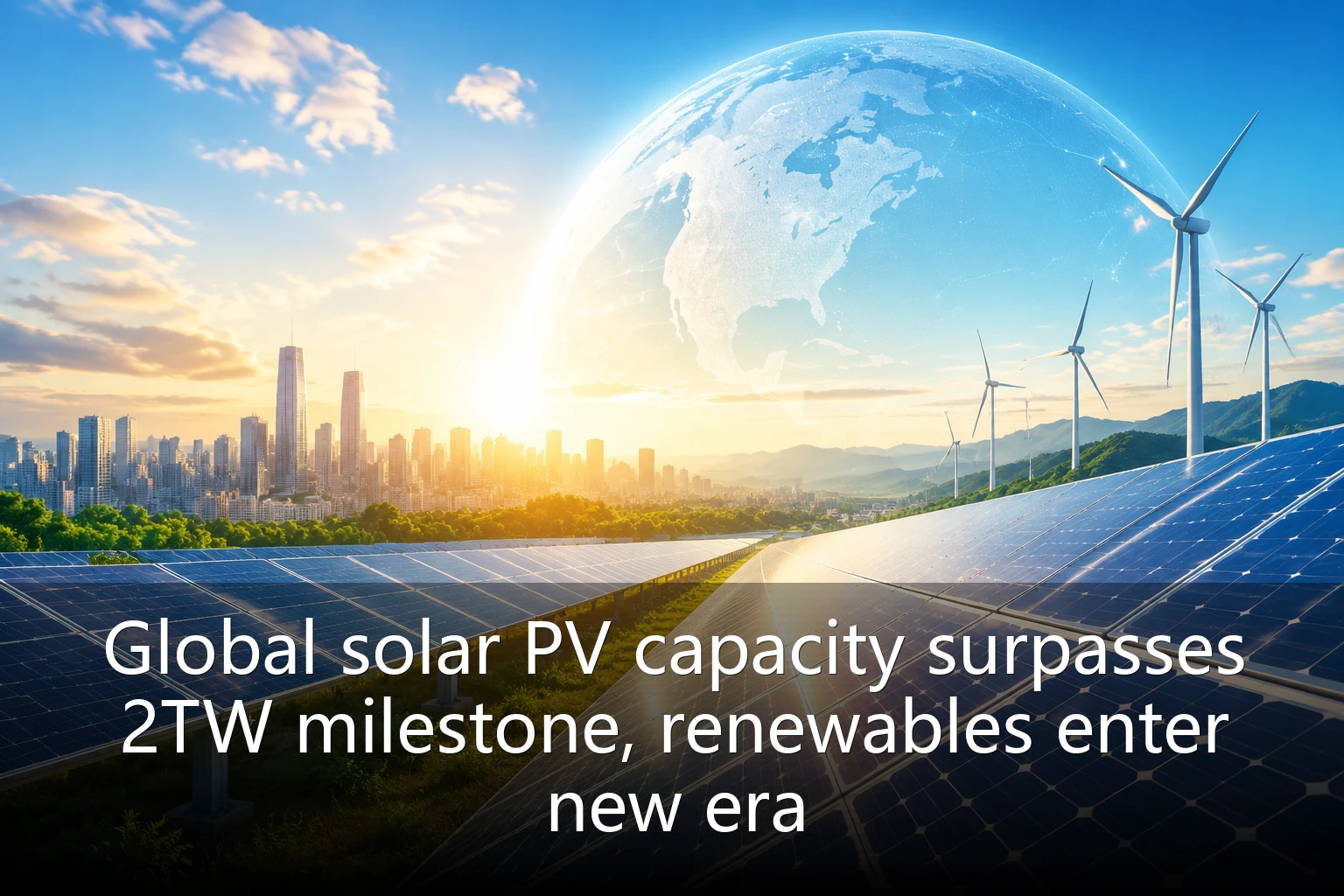
On July 28, 2026, the International Energy Agency (IEA) and the Global Solar Council jointly announced that as of end-June 2026, global solar PV capacity officially surpassed the 2-terawatt (TW) mark. This milestone comes just three years after exceeding 1TW in 2023, marking a doubling in capacity and signaling that solar PV has evolved from a supplementary energy source to a core pillar of global power systems. The achievement not only reshapes the global energy consumption landscape but also provides a solid technological foundation for combating climate change.
Historic Shift in Global Energy Consumption
According to the IEA's latest Global Energy Outlook report, global energy consumption grew 2.1% year-on-year in the first half of 2026, down from 2.8% in the same period of 2025, while renewable energy's share of electricity generation rose to 36%, with solar PV contributing over half of the new generation. The 2TW capacity is equivalent to the generating capacity of about 2,500 nuclear reactors, meeting roughly 8% of global electricity demand. In sun-rich regions, solar is already the cheapest electricity source, accelerating coal phase-outs in many countries. The International Renewable Energy Agency (IRENA) said the explosive growth from 1TW to 2TW was driven mainly by strong policy support and cost declines in China, India, Europe and the United States.
China: Dominant Force in Global PV Installations
As the world's largest PV market, China's cumulative installed capacity reached about 1.2TW by end-June 2026, accounting for 60% of the global total. In the first half of 2026, China added over 150GW, up 35% year-on-year, far exceeding early expectations. China's National Energy Administration data shows distributed PV accounted for over 50% for the first time, with residential PV penetration exceeding 25% in Shandong, Hebei and other provinces. Moreover, China produces over 80% of the world's PV modules, and technological progress has pushed module prices below $0.08 per watt, further stimulating global installation enthusiasm. Notably, China's large-scale wind and solar bases in deserts, Gobi and barren lands are expected to add over 200GW of centralized PV by end-2026, potentially pushing global installations to 3TW ahead of schedule in 2027.
Europe: Energy Security Drives Solar Acceleration
Affected by the energy crisis after the Russia-Ukraine conflict, European countries see solar as a key lever for energy independence. In the first half of 2026, the EU added about 60GW of PV, up 28% year-on-year, led by Germany, Spain and the Netherlands. The EU's Renewable Energy Directive requires a 45% renewable energy share by 2030, with solar seen as the easiest target to achieve. In particular, Nordic countries are building 100% renewable energy systems leveraging the complementarity of solar and wind. Additionally, the phased implementation of the EU Carbon Border Adjustment Mechanism (CBAM) forces high-carbon industries to purchase green electricity, indirectly boosting commercial and industrial distributed PV demand.
United States: Inflation Reduction Act Continues to Drive Gains
Driven by the Inflation Reduction Act (IRA), U.S. PV installations have entered a rapid growth phase. In the first half of 2026, about 35GW were added, pushing cumulative capacity above 300GW. The U.S. Energy Information Administration (EIA) forecasts that solar will account for over 60% of new U.S. power capacity in 2026. California, Texas and Florida are the main growth engines, while community solar and residential storage systems have significantly boosted household participation. However, the U.S. still faces grid connection bottlenecks and transformer shortages, though domestic PV manufacturing capacity is accelerating, with supply chain bottlenecks expected to ease gradually after 2027.
Technology and Costs: From Efficient to Intelligent
The breakthrough of 2TW PV installations is underpinned by sustained cost declines from technological advances. Laboratory efficiency of perovskite-silicon tandem cells has exceeded 35%, and several companies plan to achieve mass production by 2027, raising conversion efficiency above 28% and further reducing levelized cost of electricity. Meanwhile, smart PV systems combining AI prediction and virtual power plant technology significantly enhance predictability and dispatch flexibility. Energy storage system costs have fallen below $150 per kWh, and PV-plus-storage has become the standard for new power plants, greatly alleviating intermittency issues. The IEA notes that as PV penetration rises, digital energy management platforms will become key infrastructure for the next phase.
Investment Perspective: Opportunities and Risks Coexist
The 2TW milestone points the way for global energy investment. PV manufacturing (polysilicon, wafers, cells, modules) and supply chain segments like inverters, trackers and storage equipment will continue to attract substantial capital. According to BloombergNEF, global PV investment reached $180 billion in the first half of 2026, up 40% year-on-year. However, investors should be wary of trade friction risks, profit compression from overcapacity, and curtailment issues due to insufficient grid absorption. A diversified investment strategy is recommended, focusing on leading enterprises with technological moats and project developers targeting emerging markets.
Outlook: 3TW Not Far Off
As global decarbonization accelerates, multiple international agencies have raised their 2030 global PV installation forecasts to 8-10TW. Green infrastructure plans in China, India, the U.S., Europe and Southeast Asia will contribute the bulk of additions. Countries along the Belt and Road Initiative, in particular, are leveraging China's cost advantages in PV modules to achieve rapid energy transitions. Furthermore, emerging applications such as offshore PV, agrivoltaics and building-integrated photovoltaics (BIPV) are expanding market boundaries. It is foreseeable that solar will transition from an auxiliary source to the dominant energy source, forming a zero-carbon power system together with wind and storage, injecting unprecedented green momentum into global energy consumption.
Overall, global solar PV capacity surpassing 2TW is a landmark moment in the history of human energy transition. This achievement not only demonstrates the scaling potential of renewable energy but also lays a solid foundation for subsequent jumps to 3TW and 4TW. For investors and practitioners monitoring global energy consumption, grasping every technological iteration and policy dividend along the PV supply chain will be key to steady returns in the new energy era.
