



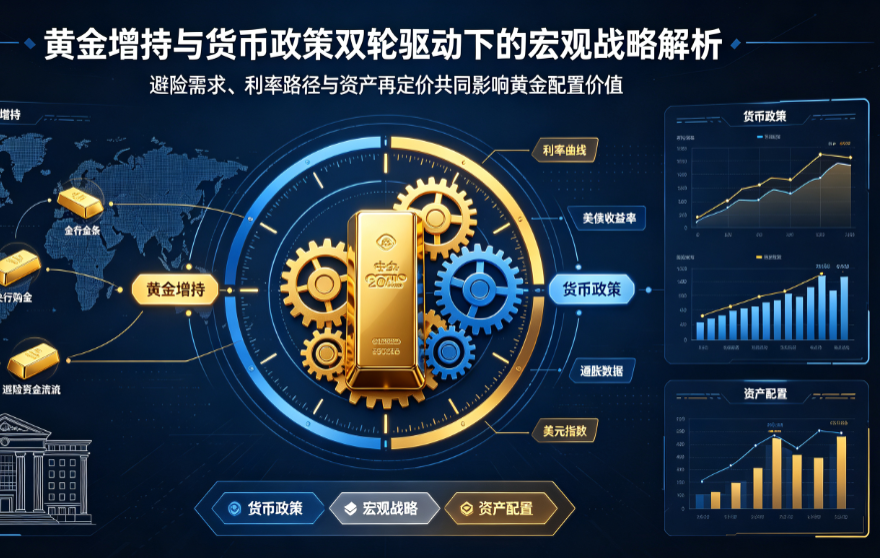
Macro strategy analysis under twin engines of continuous gold accumulation and monetary policy
Introduction
Against the backdrop of profound adjustments in the global economy and heightened volatility in international financial markets, China has recently shown two important signals in the financial sector: first, it has increased gold reserves for 20 consecutive months, reaching 75.44 million ounces by the end of June 2023; second, the monetary policy committee of the People's Bank of China stated in its Q2 2023 meeting that it will implement moderately loose monetary policy, strengthen counter-cyclical adjustment, and focus on expanding domestic demand. These two measures echo each other, outlining the current direction and strategic considerations of macroeconomic policy. This article conducts an in-depth analysis and interpretation.
Strategic considerations behind continuous gold reserve increase
Safe haven choice amid global uncertainty
The 20-month consecutive increase in gold is no coincidence, but based on prudent judgment of the complex international environment. Currently, geopolitical risks are heating up, global inflation pressures are high, and the dollar credit system faces challenges. These factors jointly drive central banks back to gold, the traditional safe haven asset. As the world's second-largest economy, China can effectively hedge external risks, optimize foreign exchange reserve structure, and reduce excessive dependence on a single currency by continuously increasing gold holdings.
Strong support for RMB internationalization
The increase in gold reserves, from a deeper perspective, provides solid credit endorsement for RMB internationalization. A currency with ample gold reserves will significantly enhance its credibility and stability in the global trade and financial system. With the deepening of the Belt and Road Initiative and the expansion of cross-border RMB settlement, sufficient gold reserves will undoubtedly endow the RMB with stronger international competitiveness.
Moderate easing shift in monetary policy
Precision in counter-cyclical adjustment
The Q2 monetary policy committee meeting emphasized "implementing moderately loose monetary policy and strengthening counter-cyclical adjustment." This statement releases a clear policy signal. Against a backdrop of weakening external demand and a still-fragile domestic recovery, moderate easing means policy space will be further opened up, and the use of RRR cuts, rate cuts, and structural monetary policy tools may become more frequent, thereby lowering financing costs for the real economy and stimulating market vitality.
Strategic focus on expanding domestic demand
"Focusing on expanding domestic demand" is placed in a prominent position, reflecting the core concern of current macro policy. Expanding domestic demand is not only a necessary means to cope with short-term downward pressure but also a fundamental path to promote high-quality long-term economic development. Through the coordination of monetary and fiscal policies, guiding financial resources to favor consumption and investment, especially increasing credit support for key areas such as SMEs, technological innovation, and green development, is expected to form a virtuous cycle of domestic demand growth and industrial upgrading.
Deep logic of the two strategies
Gold accumulation and monetary easing may appear to be policy operations in different directions, but they have internal unity. On one hand, external uncertainty requires the central bank to enhance asset safety, and gold accumulation embodies this logic; on the other hand, the urgent task of stabilizing growth and employment at home requires moderately loose monetary policy to activate endogenous growth momentum. Both serve the fundamental goal of "coordinating development and security," holding the risk bottom line while stimulating economic vitality.
Conclusion
In summary, China's 20 consecutive months of gold accumulation and the shift to moderately loose monetary policy constitute two pillars of the current macroeconomic policy framework. The former focuses on hedging external risks and strategic asset allocation, while the latter aims to stimulate domestic demand and economic repair. In the new phase of high global economic volatility, this policy combination that "balances internal and external, seeks progress while maintaining stability" reflects the foresight and determination of the decision-makers and provides a solid guarantee for stable and healthy economic development. Looking ahead, with continued policy efforts and deeper structural reforms, China's economy is expected to carve out a path of steady recovery and structural optimization in a complex environment.
