


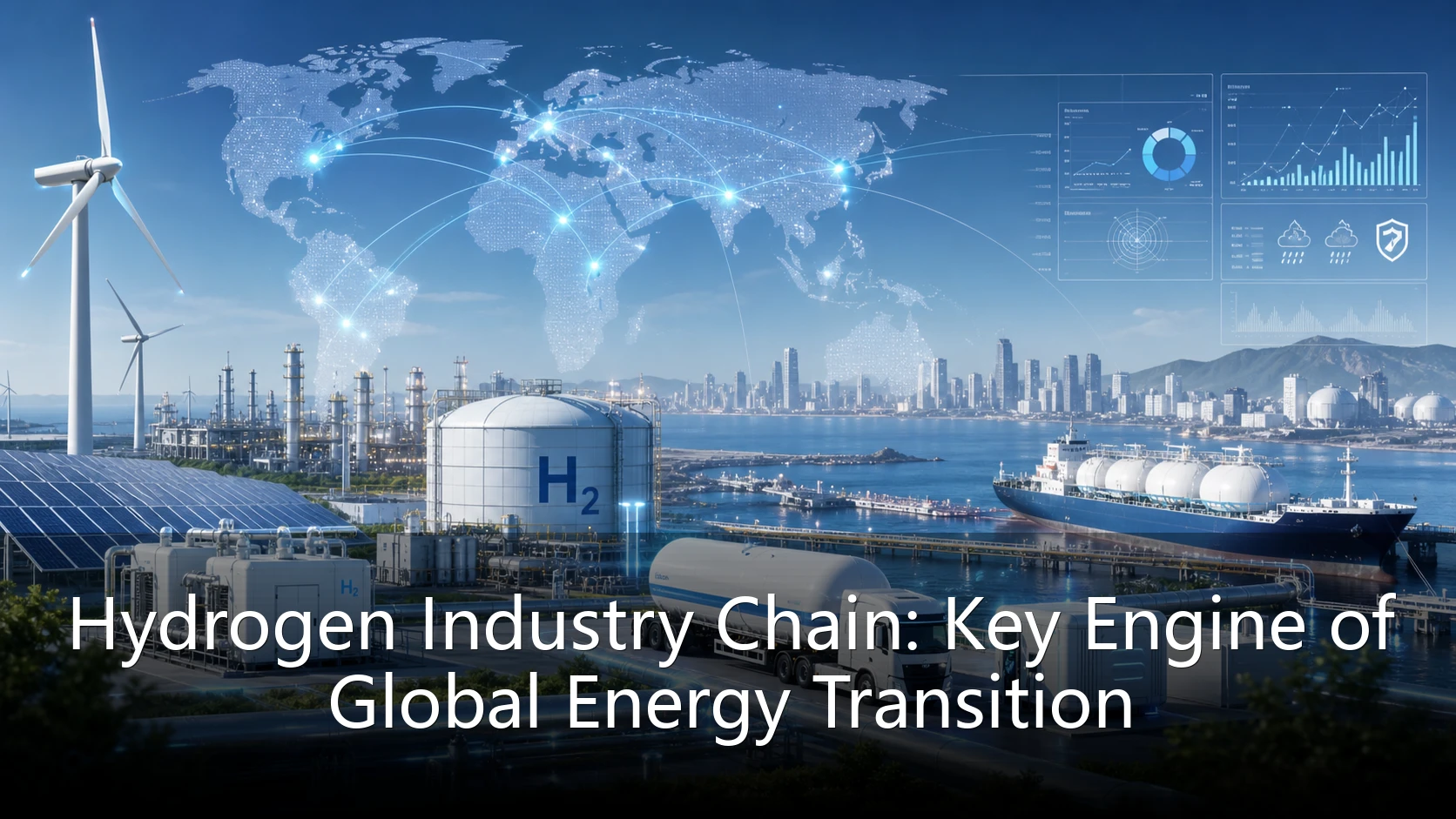
The global energy transition is advancing at an unprecedented speed. Among many new energy technologies, hydrogen, as a clean, efficient, and flexible energy carrier, is gradually moving from the periphery to the center stage. The hydrogen industry chain includes multiple links such as hydrogen production, storage, transportation, and application, and is an important part of the future energy system. This article will comprehensively analyze the development status and future trends of the global hydrogen industry chain from four dimensions: driving factors, transmission logic, possible scenarios, and risks.
\n\nOverview of the Hydrogen Industry Chain
\n\nThe hydrogen industry chain refers to the entire process from hydrogen production, storage, and transportation to final application. Depending on the production method, hydrogen can be divided into gray hydrogen (produced from fossil fuels), blue hydrogen (produced with carbon capture and storage technology), and green hydrogen (produced by electrolyzing water with renewable energy). Currently, global hydrogen production is still dominated by gray hydrogen, but as the cost of renewable energy decreases and technology advances, the proportion of green hydrogen will gradually increase.
\n\nThe application fields of hydrogen energy are extensive, including transportation, industrial production, building heating and power generation. In the transportation sector, hydrogen fuel cell vehicles are considered an important supplement to electric vehicles, especially suitable for long-distance heavy-duty transportation; in the industrial sector, hydrogen can replace fossil fuels as a raw material, reducing carbon emissions; in terms of power generation and energy storage, hydrogen can provide long-cycle energy storage solutions, compensating for the shortcomings of intermittent renewable energy.
\n\nAnalysis of Driving Factors
\n\nPolicy Support and Carbon Neutrality Goals
\n\nThe advancement of global carbon neutrality goals is the core driving force for hydrogen development. Major economies such as the European Union, China, and the United States have successively incorporated hydrogen into their national energy strategies, supporting the development of the hydrogen industry by formulating hydrogen development roadmaps, providing financial subsidies, and establishing carbon pricing mechanisms. For example, the EU's Hydrogen Strategy plans to install at least 40GW of electrolyzers by 2030 to produce 10 million tons of renewable hydrogen; China's 'Medium and Long-term Development Plan for the Hydrogen Industry (2021-2035)' clearly states that the output value of the hydrogen industry will reach 1 trillion yuan by 2025.
\n\nTechnological Progress and Cost Reduction
\n\nIn recent years, significant breakthroughs have been made in hydrogen-related technologies. The efficiency of electrolyzers continues to improve, and costs continue to decrease. It is expected that by 2030, the cost of electrolytic hydrogen production may fall below $1.5 per kilogram; advances in fuel cell technology have significantly improved the range and reliability of fuel cell vehicles; hydrogen storage and transportation technologies are also continuously optimized, and technologies such as high-pressure gaseous hydrogen storage, liquid hydrogen storage, and solid hydrogen storage are becoming increasingly mature.
\n\nEnergy Security and Diversification Needs
\n\nGeopolitical factors are driving countries to seek diversification of energy supply. Hydrogen can be an important choice for energy-importing countries to reduce dependence on foreign countries, and it can also be a development direction for energy-exporting countries to open up new markets. For example, resource-rich regions such as Australia and the Middle East are actively developing hydrogen export industries; while energy-importing countries such as Japan and South Korea regard hydrogen as a key path to ensure energy security.
\n\nIndustrial Upgrading and Investment Growth
\n\nGlobal hydrogen industry investment is showing rapid growth. According to data from the International Energy Agency (IEA), global hydrogen project investment reached about $30 billion in 2022, an increase of more than 50% compared to 2021. Traditional energy companies, automobile manufacturers, power companies, and professional hydrogen companies are increasing their investment to promote the coordinated development of all links in the industry chain.
\n\nAnalysis of Transmission Logic
\n\nPath from Technological Innovation to Commercialization
\n\nThe development of the hydrogen industry follows a typical technological innovation diffusion curve. From laboratory R&D to demonstration projects, then to commercial applications, and finally to large-scale expansion, each stage requires corresponding policy support, market cultivation, and infrastructure support. Currently, the hydrogen industry is in a critical stage of transitioning from demonstration projects to commercial applications, and it is necessary to further reduce costs through large-scale applications to form a virtuous cycle.
\n\nCycle of Cost Reduction to Scale Effects
\n\nThe key to the development of the hydrogen industry is to form a positive cycle of 'cost reduction - scale expansion - further cost reduction'. As the production scale of core equipment such as electrolyzers expands, the unit manufacturing cost will continue to decrease; at the same time, as the cost of renewable energy generation decreases, the economy of electrolytic hydrogen production will be further improved; and the expansion of hydrogen application scenarios will in turn promote the expansion of production scale, forming a positive interaction.
\n\nTransition from Policy Guidance to Market Mechanisms
\n\nIn the early stage of hydrogen industry development, strong policy support is needed, including R&D subsidies, tax incentives, and demonstration project funding. As technology matures and costs decrease, policy support will gradually shift from direct subsidies to market-based mechanisms such as carbon pricing and green certification, ultimately achieving fair competition between hydrogen and traditional energy. This transition process requires policymakers to accurately grasp the timing to avoid withdrawing support policies too early or too late.
\n\nAnalysis of Possible Scenarios
\n\nOptimistic Scenario: Hydrogen Becomes an Important Part of the Energy System
\n\nIn the optimistic scenario, hydrogen will become an important part of the global energy system before 2050. The cost of renewable energy electrolytic hydrogen production will decrease significantly, and the proportion of green hydrogen will exceed 50%; hydrogen fuel cell vehicles will account for 15-20% of the global car fleet; hydrogen will achieve large-scale application in high-carbon emission industrial sectors such as steel and chemicals; global hydrogen trade will form, and hydrogen energy infrastructure networks will be basically complete. In this scenario, hydrogen's contribution to global carbon reduction will reach 10-15%.
\n\nNeutral Scenario: Hydrogen Achieves Large-scale Application in Specific Fields
\n\nIn the neutral scenario, hydrogen will mainly achieve large-scale application in specific fields, such as long-distance heavy-duty transportation, decarbonization of the steel industry, and seasonal energy storage. The cost of green hydrogen will decrease but will not achieve comprehensive competitive advantage, and hydrogen trade will be limited to regional markets; hydrogen fuel cell vehicles will mainly break through in the commercial vehicle sector; hydrogen's contribution to global carbon reduction will be about 5-10%. In this scenario, hydrogen becomes an important supplement to the energy transition rather than a substitute.
\n\nPessimistic Scenario: Development Speed Falls Short of Expectations
\n\nIn the pessimistic scenario, hydrogen development faces multiple challenges, technological breakthroughs fall short of expectations, cost reduction is slow, policy support weakens, and infrastructure construction lags behind. Hydrogen is mainly limited to small-scale demonstration projects and is difficult to achieve commercial breakthroughs; hydrogen fuel cell vehicles are only limited in specific areas and fields; hydrogen's contribution to global carbon reduction is less than 5%. In this scenario, hydrogen fails to fully play its role in the energy transition.
\n\nRisk Analysis
\n\nTechnology Risks
\n\nThe hydrogen industry still faces multiple technical challenges. The efficiency and lifespan of electrolyzers need to be further improved, fuel cell catalyst and membrane electrode technology need breakthroughs, and the safety and economy of hydrogen storage and transportation still need to be optimized. In addition, technical standards for various links in the hydrogen industry chain have not yet been unified, which may lead to low efficiency of industry chain coordination. The uncertainty of technological breakthroughs is one of the main risks facing the development of the hydrogen industry.
\n\nEconomic Risks
\n\nThe economy of the hydrogen industry faces multiple challenges. Currently, the cost of green hydrogen is still significantly higher than gray hydrogen and blue hydrogen, lacking market competitiveness; hydrogen energy infrastructure construction requires huge investment and has a long payback period; the economy of hydrogen energy application scenarios has not been fully verified, and market acceptance is uncertain. Insufficient economy may lead to slow development of the hydrogen industry and difficulty in achieving large-scale breakthroughs.
\n\nMarket Risks
\n\nThe development of the hydrogen market faces risks such as insufficient infrastructure, poor industry chain coordination, and unclear business models. The slow progress of infrastructure construction such as hydrogen refueling stations restricts the development of hydrogen fuel cell vehicles; the uneven development of various links in the hydrogen industry chain may lead to resource misallocation; the business model of hydrogen energy has not yet matured, and investor confidence is insufficient. Market risks may hinder the healthy development of the hydrogen industry.
\n\nPolicy Risks
\n\nThe development of the hydrogen industry highly depends on policy support, and policy changes may bring significant risks. Insufficient coordination of hydrogen policies among countries may lead to the fragmentation of the global hydrogen market; imperfect carbon pricing mechanisms may not reflect the environmental value of hydrogen; policy support may change with government changes, affecting the long-term development expectations of the industry. Policy risk is a risk factor that needs to be focused on in the development of the hydrogen industry.
\n\nConclusion and Outlook
\n\nAs an important path for the global energy transition, hydrogen is facing unprecedented development opportunities. Driven by multiple factors such as policy support, technological progress, energy security, and industrial investment, the hydrogen industry chain will gradually improve, costs will continue to decrease, and application scenarios will continue to expand. However, the development of the hydrogen industry still faces multiple risks in technology, economy, market, and policy, requiring the joint efforts of the government, enterprises, scientific research institutions, and other parties to jointly promote the healthy development of the hydrogen industry.
\n\nLooking to the future, the hydrogen industry will show the following development trends: first, the proportion of green hydrogen will gradually increase and become the mainstream method of hydrogen production; second, the application scenarios of hydrogen will expand from the transportation sector to industrial, construction, and power generation sectors; third, hydrogen energy infrastructure will gradually improve, forming regional and global hydrogen trade networks; fourth, the hydrogen industry will be deeply integrated with other new energy technologies to jointly build a clean and low-carbon energy system.
\n\nFor policymakers, they should strengthen the top-level design of the hydrogen industry, improve the policy support system, and promote the internationalization of hydrogen standards; for enterprises, they should increase R&D investment, reduce production costs, expand application scenarios, and build a collaborative innovation industry ecosystem; for scientific research institutions, they should focus on key technological breakthroughs, strengthen basic research, and provide technical support for the development of the hydrogen industry. Only through multi-party coordination can the key role of hydrogen in the global energy transition be fully utilized, achieving a win-win situation for carbon neutrality goals and sustainable economic development.
