


Balance Amid Fog: Global Markets in Geopolitical and Economic Transition
Keywords
Gold, Dollar, US Stocks, US-Iran Conflict, Strait of Hormuz, Carbon Fiber, C909, AI Prediction, Korean Stock Market
Introduction
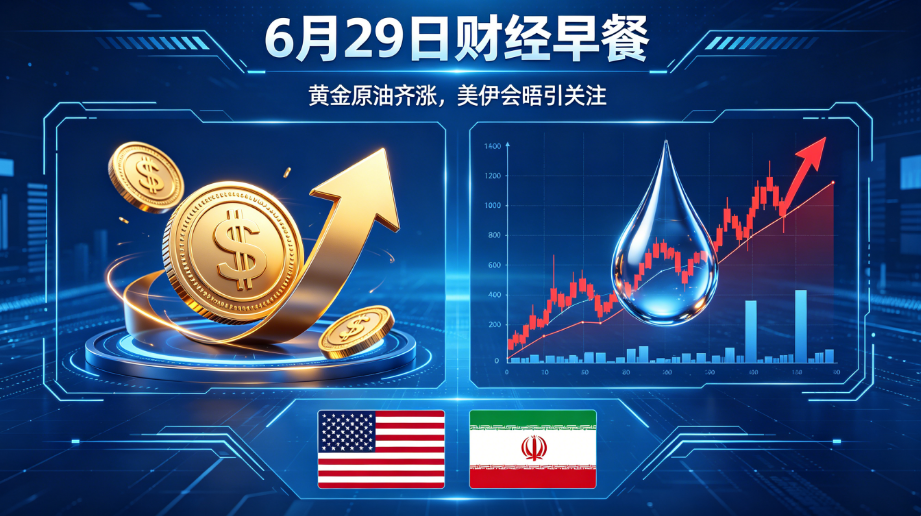
On June 29, 2025, global financial markets presented a complex and contradictory pattern amid multiple uncertainties. Spot gold traded around $4,069/oz, although the weekly line extended a fourth consecutive drop, the day's rebound showed the market's immediate reaction to a weaker dollar and slightly eased rate hike expectations. Meanwhile, WTI crude opened up over 1% near $70/barrel, but it failed to conceal the double failure of both last week—Brent crude fell 1.9% and WTI fell 1.72%.
All this is set against the background of escalating US-Iran conflict, the Strait of Hormuz transit rights game entering a heated phase, and the continuing ambiguity of the Fed's monetary policy path. In Asia, Korean stocks repeatedly triggered circuit breakers, exposing structural risks of "foreign selling, retail leveraging up"; China reached milestone breakthroughs in carbon fiber and regional aviation. Global markets are at a crossroads torn by multiple contradictions.
1. Gold Market: Safe-Haven Glimmer Obscured by Interest Rate Shadow
Spot gold closed up 1.3% on Friday at $4,026.51/oz, mainly boosted by the dollar's retreat from recent highs and a slight easing of rate hike expectations after the Fed's preferred inflation gauge—May PCE rising 4.1% YoY—came in line with expectations. Specifically, traders' bets on a September rate hike fell from 64% to about 59%.
However, gold's weekly line still fell 2.1%, extending a fourth consecutive weekly decline. Core logic: higher rates and tighter monetary policy continue to weaken the appeal of non-yielding assets. Under the dual pressure of stubborn inflation (US May inflation rose above 4% due to higher energy prices) and economic slowdown, gold's safe-haven function is significantly suppressed by the high-rate environment.
Other precious metals also rebounded together; spot silver, platinum, and palladium rose 2.2%, 2%, and 2.5% respectively, but all three fell last week. Notably, the price decline led to India's gold premium appearing for the first time in a month and a half, with marginal physical demand recovery potentially providing some support. But medium-term, if the Fed maintains a hawkish stance, gold's rebound space will be limited.
2. US Stocks: AI Feast Meets "Blood Supply" Questions
The S&P 500 fell 0.05% on Friday to 7,353.95, the Nasdaq fell 0.24% to 25,297.62, and the Dow fell 0.09% to 51,876.11. But weekly data was more alarming: the S&P 500 cumulatively fell 2.05%, the Nasdaq plummeted 4.7%, the PHLX chip index fell 5.3% in a single day and 7.9% for the week.
The core reason for this rout is investor concerns about whether the huge capital expenditures on AI data centers can be recouped quickly. News that OpenAI is considering delaying its IPO until next year further dampened AI-related risk sentiment. In technical depth, this reflects the capital market's first systematic examination of the current AI industry's "money-burning" model. When the return cycle of infrastructure investment shifts from "certainty expectations" to "uncertainty considerations," the entire valuation system can loosen.
Sector divergence intensified: despite Apple rebounding 3.1% after a selloff triggered by price hikes, chip stocks were broadly under pressure; ON Semiconductor fell nearly 24% on its acquisition of Synaptics, and the latter fell 3.7%; healthcare stocks rose strongly, with Moderna surging nearly 13% to a 2024 high after investor events. Of the S&P 500's 11 sectors, 8 fell, with industrials and materials leading declines, down 3.41% and 2.45% respectively.
Economically, US May inflation rose above 4%, and Apple's price hike is seen as a new signal of inflationary pressure. Although the easing of Middle East tensions caused oil prices to fall, and June consumer confidence rebounded from a historical low, household concerns about living costs have not dissipated. Traders expect at least one 25 bps rate hike within the year, with a near 27% probability of another hike. This means huge uncertainty remains in market pricing of interest rates.
3. Oil Market: Geopolitical Risk Premium Amid Supply-Demand Game
Oil prices suffered a heavy fall on Friday, mainly because more tankers continued to pass through the Strait of Hormuz, significantly easing supply concerns triggered by a previous attack on a cargo ship near Oman. Meanwhile, oil giant Saudi Aramco resumed crude loading operations at the Ras Tanura terminal after a nearly four-month shutdown, with shipping data showing multiple VLCCs have started loading.
However, the weekend escalation of the US-Iran conflict made the market reassess risks. The US military again struck Iranian targets; Iranian Foreign Minister Araghchi declared that for the next 30 days, the Strait of Hormuz would be fully controlled by Iran, and any intervention would delay reopening. This situation of "easing first, escalation later" plunges the oil market into a typical cycle of "geopolitical risk - supply concerns - expectation recovery - risk recurrence."
From a technical perspective, although crude oil shipping volume through the Strait last week rose to the highest since the US-Israel-Iran conflict in late February, overall traffic remains far below the daily average before the war. This means that on one hand, the actual supply gap is limited, but on the other hand, the fear of "potential supply cutoff at any time" will persist. The medium-term trend depends on the outcome of US-Iran talks in Doha and the pace of conflict escalation.
4. Forex Market: Yen's "Crisis and Opportunity" Amid Dollar Strength
The dollar fell for the second consecutive day on Friday, as key US inflation data met expectations and falling oil prices slightly cooled market expectations for Fed rate hikes. However, the dollar index still rose for the week and recorded its largest monthly gain since July last year. The dollar index fell 0.09% to 101.36 on the day; the euro rose 0.18% against the dollar to 1.1389; the pound rose 0.09% to 1.3203.
Most notable is the yen. USD/JPY edged down 0.02% to 161.74, still near the lowest since 1986 at 161.96, with markets wary of possible intervention by Japanese authorities. This extreme exchange rate essentially reflects the direct mapping of the widening US-Japan interest rate differential. Tokyo's June core inflation accelerated, providing some support for the yen, but Wells Fargo recommends strategic shorting of USD/JPY ahead of this week's US employment report, still favoring a medium to long-term bullish view on the dollar. This reflects significant divergence on whether the yen has room to depreciate further.
5. International News: US-Iran Conflict Dominates Geopolitical Risk
The US and Iran agreed to stop airstrikes and plan to meet in Doha on Tuesday to salvage the collapsed ceasefire deal. A US official told media that the two sides decided to "cease all military operations," but during technical talks, "ships can navigate freely." However, as of Saturday, the coordination hotline had not been opened, and Iran has again claimed that ships need coordinated passage.
Trump's tough remarks on social media further heightened tensions. He threatened, "The Islamic Republic of Iran will cease to exist." This game model of "negotiate while escalating" makes geopolitical risk a systemic variable that financial markets cannot ignore.
Notably, as the World Cup 32 teams were finalized, AI prediction results were also announced: Tencent Hunyuan ranked first with an accuracy of 29/32. Although this incident does not directly affect financial markets, it reveals the potential and limitations of AI technology in predicting complex systems—high consistency for strong teams with certainty, but significant differences in marginal decisions.
6. Domestic News: Industrial Upgrades Add Resilience
Against the backdrop of global market volatility, positive signals came from China's industrial sector. Three world-class high-performance carbon fiber production lines were put into operation at Zhongfu Shenying's Lianyungang base, covering general, high-strength, and high-modulus carbon fiber categories. This marks another milestone for China's carbon fiber industry. Technically, the 5,000-ton large-tow carbon fiber line uses pioneering dry-jet wet spinning technology and upgraded wind power-specific products; the world's first 4-meter wide-width thousand-ton T1100-grade line is fully adapted to aerospace and other high-end extreme scenarios; the 600-ton high-modulus carbon fiber line empowers high-end equipment, 3C electronics, etc. This is not just capacity expansion but a clear signal of industry transformation from homogeneous competition to technology- and specialization-oriented development.
Meanwhile, the domestic commercial aircraft C909 has been in commercial operation for 10 years, with 186 units delivered, accounting for 70% of the domestic regional fleet. This marks the formation of a complete autonomous supply chain in China's regional aviation transport market, providing solid support for the independence of the domestic aviation industry chain.
These two cases together reveal an important trend: amid increasing external uncertainty, China is building a "resilience base" to cope with fluctuations through core technology autonomy and industrial upgrading.
Conclusion
Current global markets are on a "balance" of multiple contradictions: one end is the ongoing game between Fed rate hike expectations and inflation pressures, the other is the uncertainty premium brought by geopolitical risks such as the US-Iran conflict; one end is the questioning of AI capital expenditure return cycles, the other is structural support from industrial upgrades and supply chain autonomy.
The rebound in gold, oil volatility, US stock fluctuations, and forex games all share the same logic: the market is repricing the economic and political order of the "post-pandemic era." Meanwhile, China's breakthroughs in carbon fiber and C909 offer another possibility for deconstructing this uncertainty—when the external environment becomes unpredictable, the accumulation of internal technological capabilities and optimization of industrial structure become the most reliable risk hedging tools.
For investors, in the current environment, shifting from "chasing trends" to "focusing on structure," from "gambling on short-term volatility" to "positioning for long-term resilience" may be the only path through the fog.
