


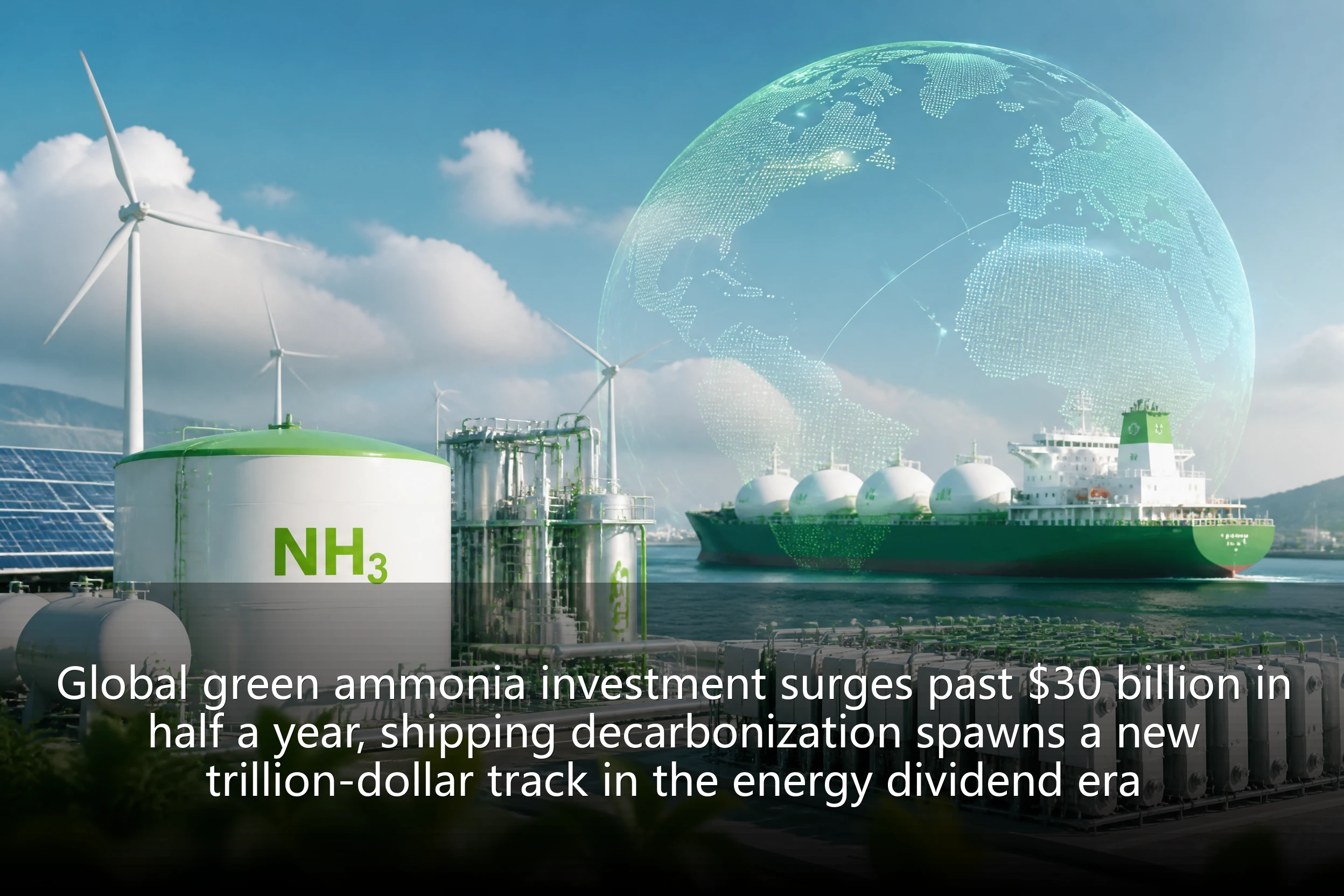
The Green Ammonia Track Suddenly Heats Up: Shipping Decarbonization Drives the $30 Billion Surge
In early August 2026, the global energy investment landscape is being quietly redrawn. According to the latest data from the International Renewable Energy Agency (IRENA) and multiple energy consultancies, the cumulative Final Investment Decisions (FID) announced for global green ammonia projects in the first half of 2026 have surpassed $30 billion, an increase of over 210% compared to the same period in 2025. This figure does not yet include reserve projects in the feasibility study stage. If long-term plans are included, the total planned global green ammonia production capacity is approaching 45 million tons per year.
The core driving force behind this investment wave is not traditional agricultural fertilizer demand, but the sudden acceleration of international shipping decarbonization. The '2025 Ship Greenhouse Gas Emission Reduction Strategy' adopted by the International Maritime Organization (IMO) at the end of 2025 explicitly requires that by 2030, the carbon emission intensity of international shipping must drop by 45% compared to 2008, and at least 5% of fuel usage must come from zero-emission sources. Green ammonia, because it contains no carbon molecules and can leverage existing liquefied gas infrastructure for storage and transport, is rapidly becoming the preferred alternative fuel for shipping giants.
This policy signal has already been transmitted to the industry. In July 2026, the world's top three container shipping companies—Maersk, Mediterranean Shipping Company (MSC), and CMA CGM—successively announced long-term green ammonia procurement agreements totaling $12 billion, locking in supply volumes for 2028 to 2035. This move is seen by the industry as a critical turning point where shipping decarbonization moves from 'commitment' to 'fulfillment'.
China's Industry Chain Goes Global: Comprehensive Leadership from Photovoltaics to Electrolyzers
In the green ammonia investment wave, China's industry chain occupies an indisputably core position. According to the latest data released by the China Hydrogen Alliance, in the first half of 2026, China's electrolyzer production capacity accounted for 68% of the global total, with alkaline electrolyzer shipments increasing by over 150% year-on-year. Companies like LONGi Hydrogen, Sungrow Hydrogen, and Huadian Heavy Industries are exporting mature water electrolysis hydrogen production technology in a 'turnkey' project model to renewable energy-rich regions such as the Middle East, North Africa, and South America.
'This is essentially the monetization of an industry chain during an energy dividend era,' pointed out the Secretary-General of the Hydrogen Energy Committee of the China Energy Research Society at an industry forum at the end of July. 'China's cost advantage in the photovoltaic sector has been replicated in electrolyzer manufacturing. Currently, the unit price of domestically produced 1000 Nm³/h alkaline electrolyzers has fallen below $180 per kilowatt, which is only about 60% of similar European products. This cost advantage has significantly accelerated the economic viability tipping point for green ammonia projects.'
It is worth noting that the explosive growth of green ammonia capacity is also driving synergistic investment across the upstream and downstream industry chain. At the hydrogen production end, N-type modules in the photovoltaic industry chain are becoming standard for green ammonia projects, as their higher conversion efficiency can increase hydrogen output per unit of land area. At the storage and transport end, liquid ammonia storage tanks and ammonia cracking hydrogen production technology have become new investment hotspots. At the application end, R&D investment in ammonia-fueled engines grew by over 80% in the first half of 2026, with MAN Energy Solutions and Wärtsilä both announcing plans for commercial delivery by 2027.
Carbon Tariff Catalysis: The Green Premium of Ammonia is Being Priced In
Another key variable driving the green ammonia investment boom is the full implementation of the EU's Carbon Border Adjustment Mechanism (CBAM). Since January 2026, the EU has officially imposed carbon tariffs on imported products such as fertilizers, steel, aluminum, and cement, and the fertilizer industry is a traditional major consumer of ammonia. According to calculations, fertilizer products using traditional coal-based ammonia will face an additional carbon cost of approximately €180 to €220 per ton when entering the EU market, which is almost equivalent to 40% to 50% of the current ammonia market price.
This policy effect is reshaping the global ammonia trade pattern. Data from the International Fertilizer Industry Association (IFA) shows that in the second quarter of 2026, the price gap between global green ammonia and traditional gray ammonia had narrowed from 2.5 times in 2024 to 1.6 times. With the superimposed effect of CBAM carbon tariffs, the actual landed cost of green ammonia in the European market has become basically on par with traditional gray ammonia, and even price inversions have occurred in certain periods. This means the green premium is being eroded by carbon pricing mechanisms, and the economic tipping point for green ammonia has arrived.
'Green ammonia is crossing from the proof-of-concept stage into a period of commercial explosion.' A private equity fund partner focused on energy transition investments told reporters, 'A key signal we observed is that in the first half of 2026, the proportion of green financial investment instruments used in the financing structure of global green ammonia projects exceeded 50% of total project investment for the first time. Green bonds, sustainability-linked loans, and carbon credit pre-sales are becoming mainstream financing methods, indicating that the capital market has started voting with its feet.'
Risks and Challenges: Overcapacity Concerns and Infrastructure Bottlenecks
However, the sudden heating up of the green ammonia track also comes with risks that cannot be ignored. Industry analysts point out that the currently announced planned green ammonia production capacity has far exceeded the estimated annual demand of about 12 million tons under the IMO's 2030 targets. If all planned projects are realized, global green ammonia capacity will experience a significant phased surplus by 2030, potentially leading the industry through a brutal shakeout between 2028 and 2030.
Furthermore, grid connection and green electricity traceability issues for green ammonia projects are becoming new bottlenecks. The EU is formulating stricter 'green hydrogen' certification standards, requiring that green ammonia production must use newly added renewable energy power, rather than drawing directly from the existing grid. If strictly enforced, this rule will pose challenges for some projects relying on direct grid supply, forcing project developers to accelerate the construction of dedicated wind or photovoltaic power stations.
From an energy investment perspective, investment opportunities in the green ammonia industry chain are spreading from upstream electrolyzer manufacturing to downstream storage and transport infrastructure and application scenarios. Sub-sectors such as ammonia cracking for hydrogen production, ammonia fuel bunkering vessels, and ammonia-powered ship retrofits are becoming new targets for capital. For investors, focusing on enterprises with full industry chain integration capabilities and green ammonia projects with locked-in long-term offtake agreements may be a prudent strategy to seize the opportunities of this energy dividend era.
Conclusion: The Next Definitive Track in the Energy Dividend Era
The explosion of the green ammonia industry is not an isolated event, but an inevitable result of the global carbon neutrality pathway advancing from the power sector into the industrial and transportation sectors. After photovoltaics and wind power proved that renewable energy can replace fossil fuels for power generation, green ammonia is proving that 'green molecules' can also replace fossil molecules—the validation of this logic will open up a new energy transition space far beyond the electricity market. For energy practitioners and investors, the green ammonia track carries not only the commercial opportunity of technological breakthroughs but also the strategic window for the energy dividend era to leap from the 'kilowatt' to the 'molecule' era.
