



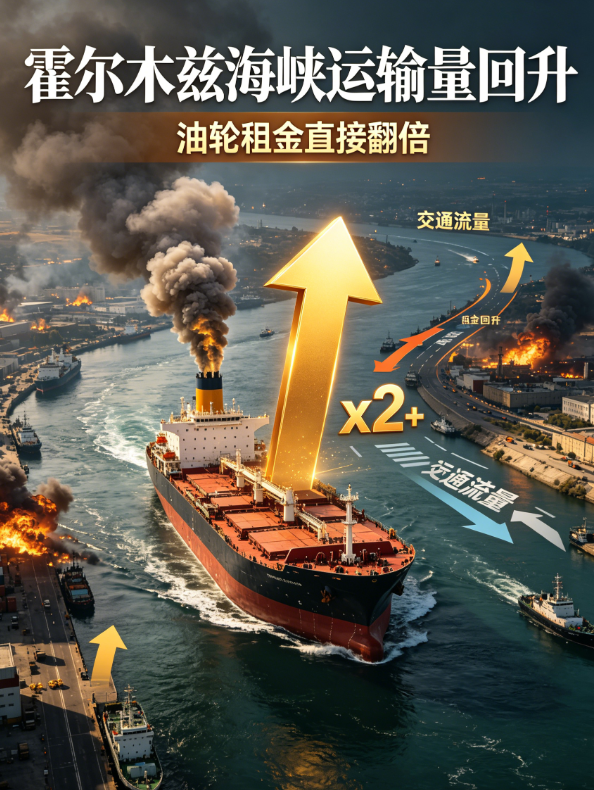
Strait of Hormuz Eases: Global Tanker Freight Soars and New Shipping Market Landscape
Keywords
Strait of Hormuz; Iran; US; Memorandum of Understanding; Tanker Freight; Shipping Market; Oil Transport; Geopolitics
Introduction
In spring 2025, the international shipping market experienced severe turbulence. As Iran and the US signed an MOU to reopen the Strait of Hormuz, this most critical oil transport channel gradually resumed normal navigation. However, shipping data reveals a striking phenomenon: despite the lifting of passage restrictions, shipping volumes through the Strait and Gulf region did not recover to pre-crisis levels as quickly as expected. Instead, supply-demand imbalance caused tanker freight rates to surge sharply. Tanker operators this week achieved record profits, prompting deep market thinking about global energy supply chain stability and cost transmission mechanisms.
Unexpected Market Reaction to Geopolitical Easing
From Blockade to Recovery: Strategic Status of the Strait of Hormuz
The Strait of Hormuz connects the Persian Gulf and the Arabian Sea, handling about one-third of global oil transport—truly the "oil chokepoint." The long-standing geopolitical game between Iran and the US has repeatedly threatened the strait with blockades. The signing of this MOU marks a phase consensus on energy security. However, the shipping market's reaction was not a simple "good news driving freight lower" but showed typical "repair premium" characteristics.
Structural Contradictions Behind Volume Recovery
According to shipbrokers and industry sources, in the first week after the MOU, the cost of chartering tankers outside the Strait of Hormuz soared from $106,500 per week to $190,500 per day, nearly doubling. Prices for vessels chartered outside the Gulf also rose sharply. Behind this seemingly anomalous phenomenon are structural contradictions inherent in the shipping market: on one hand, vessels previously forced to suspend or divert due to the blockade need time to redeploy; on the other hand, shipowners and charterers, eager to lock in capacity after uncertainty was removed, caused a sudden demand explosion.
Multiple Drivers of Freight Surge
Short-Term Impact of Supply-Demand Imbalance
During the Strait closure, a large number of tankers were forced to detour around the Cape of Good Hope or remain stranded outside the Gulf, increasing voyage time and causing capacity mismatch. When the strait reopened, oil producers and traders immediately started restocking, but available tanker numbers did not increase simultaneously. This contradiction between "suddenly released demand" and "limited immediate supply" directly pushed freight rates to historic highs. Analysts note that tanker operator profits this week have exceeded the peak after the 2022 Russia-Ukraine conflict, fully reflecting the elasticity of capacity pricing in extreme market conditions.
Insurance and Risk Premiums Continue to Rise
Even with the situation easing, shipowners and insurers still charge high war risk surcharges for vessels transiting the area. Data from the international insurance market show that war risk premiums for the Strait of Hormuz are still about 300% higher than pre-crisis levels. This cost is passed on to charter rates, further boosting spot freight. Additionally, some shipowners remain cautious about long-term safety and prefer short-term, high-premium contracts over locking in long-term low-price orders.
Structural Adjustment in Energy Trade Flows
Notably, this freight surge is not limited to Strait-related routes but extends to major global tanker routes. Vessel prices chartered outside the Gulf also rose significantly, reflecting profound adjustments in global oil trade flows. After the Iran-US agreement, the market expects Asian buyers to increase crude imports from Iran, while Europe may turn to US or African crude. This shift in trade patterns generates new shipping demand, especially for VLCC and Suezmax tankers.
Market Outlook and Potential Risks
Short-Term Freight Likely to Stay High and Volatile
From a supply-demand perspective, current tanker capacity utilization is near full, and new vessel deliveries from 2024 to 2025 are limited. Even if the Strait fully returns to normal, effective global tanker capacity cannot be quickly released. Spot freight is expected to remain in the $150,000-$200,000 per day range over the next 1-3 months, significantly above the 5-year average.
Geopolitical Risk Remains Largest Variable
Although the MOU provides a phase solution, fundamental contradictions between Iran and the US have not disappeared. Any developments related to sanctions enforcement, nuclear negotiations, or military actions could trigger sharp volatility in shipping markets again. Shipowners and charterers need to establish flexible risk hedging mechanisms, such as locking in costs via forward freight agreements or diversifying route dependence.
Spillover Effects on Global Energy Prices
The surge in tanker freight directly increases the landed cost of crude oil. For Asian refineries, the freight increase adds an extra $2-3 per barrel. If this persists, it could push global oil prices further higher, exacerbating inflation pressures worldwide. Meanwhile, high freight may prompt some buyers to turn to pipeline transport or local energy, accelerating regional energy supply chain restructuring.
Conclusion
The reopening of the Strait of Hormuz is undoubtedly a positive signal for international energy markets, but the irrational surge in shipping freight precisely reveals the profound impact of geopolitical events on markets. Tanker operators have made excess profits in the short term, but the entire industry faces long-term structural uncertainty and cost pressures. For policymakers and market participants, relying solely on "optimistic signals" is no longer sufficient to cope with complex shipping markets. More effective strategies should strengthen multilateral cooperation, establish stable energy transport corridors, and enhance supply chain resilience by investing in port facilities and maintaining emergency capacity. Only then can global oil transport fundamentally escape the predicament of "soaring upon clearance" and return to a stable, sustainable development track.
(Full text approx. 1280 words)
