


 <\/div><\/div>
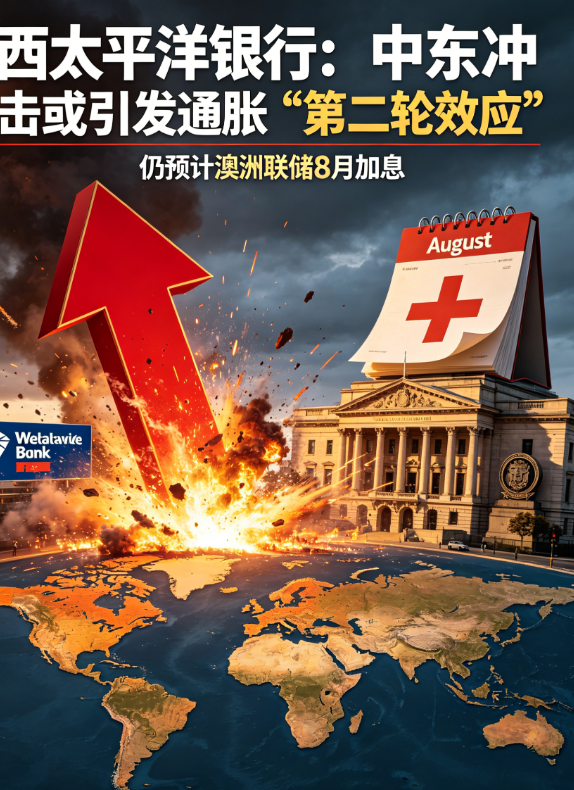
Rate Decision Amid Inflation Fog: Westpac Maintains August Rate Hike Forecast for the RBA<\/h1>\nKeywords<\/h2>\n
Reserve Bank of Australia, rate hike expectations, CPI data, second-round effects, wage cost pressure, Middle East supply shock, policy withdrawal<\/p>\n
\n
Introduction<\/h2>\n
On June 24, 2025, the Australian Bureau of Statistics released the May Consumer Price Index (CPI) data, which unexpectedly fell below market expectations, briefly boosting some investors' optimism that inflation had peaked. However, Westpac swiftly released a research report after the data release, clearly maintaining its forecast that the Reserve Bank of Australia (RBA) will raise interest rates at its August meeting. This stance, seemingly contradicting the data, hides a deep insight into the structural pressures of inflation: short-term fluctuations cannot obscure the persistent root causes of inflation. This article will systematically analyze the logic behind Westpac's maintained rate hike forecast from four dimensions: data interpretation, shock transmission mechanisms, policy environment, and labor market evolution, and explore the RBA's decision-making dilemma in the complex inflation landscape.<\/p>\n
\n
I. Data Surface vs. Substance: Potential Pressures Masked by Seasonal Factors<\/h2>\n1.1 Lower-than-Expected CPI: Structural or Cyclical?<\/h3>\n
The year-on-year increase in the May headline CPI moderated from April, falling below the consensus market expectation. By component, the drag came mainly from travel, clothing, and entertainment prices. Westpac clearly points out that the price declines in these areas have distinct seasonal characteristics — the autumn/winter tourism demand decline in the Southern Hemisphere, seasonal clothing discounts, and the off-season effect in entertainment activities — collectively leading to a weaker short-term reading. Such seasonal fluctuations have appeared in previous years and do not alter the medium-term inflation trend.<\/p>\n
Notably, after excluding volatile food and energy prices, the core CPI (Trimmed Mean CPI) remains at a relatively high level. Westpac emphasizes that core inflation indicators better reflect underlying inflationary pressures, and the core data for May showed no significant improvement. This means that even if the short-term reading is lower, the underlying forces driving inflation higher remain strong.<\/p>\n
1.2 Data "Noise" and Policy Signals<\/h3>\n
Inflation data has never been a one-dimensional barometer. For monetary policymakers, the "noise" in a single month's data can easily distort policy judgement. Westpac believes that the RBA should focus more on trend indicators rather than monthly fluctuations. Viewed from a three-month or six-month moving average perspective, the annualized CPI growth rate remains above the upper bound of the 2%-3% target range. More importantly, services inflation — especially the price stickiness in market-based service industries (such as healthcare, education, and dining) — has shown no clear signs of easing. This assessment is highly consistent with recent statements from several central banks (the Fed, the ECB): services inflation is the most stubborn fortress in the "last mile."<\/p>\n
\n
II. Second-Round Effects of the Middle East Supply Chain Shock: Spreading from Energy to Multiple Sectors<\/h2>\n2.1 Reassessment of the First-Round Impact<\/h3>\n
From late 2024 to early 2025, geopolitical tensions in the Middle East led to a sharp rise in international oil prices, which in turn drove up domestic fuel prices in Australia. This was a typical first-round effect: energy costs directly pushed up the gasoline and diesel components of the CPI. However, Westpac's report warns that the more concerning factor is the second-round effect — the transmission of energy price increases through production chains to downstream products.<\/p>\n
2.2 Specific Channels of Second-Round Effects<\/h3>\n
The May data "more strongly indicates that the second-round effects of the Middle East supply shock are widening." Westpac lists key transmission chains:<\/p>\n
- \n
- Fuel and Transportation<\/strong>: Rising diesel and gasoline prices directly increase road transport costs, thereby pushing up prices of all goods dependent on transportation, from fresh food to construction materials.<\/li>\n
- Plastics and Chemical Products<\/strong>: Crude oil is a core input for plastics and chemicals. Higher oil prices drive up the cost of basic resins such as polyethylene and polypropylene, which are then passed on to packaging materials, pipes, daily necessities, and other areas.<\/li>\n
- Fertilizers and Pesticides<\/strong>: Natural gas prices (the Middle East is also a major production region) affect nitrogen fertilizer production costs, and higher agricultural input costs ultimately reflect in food prices.<\/li>\n<\/ul>\n
Notably, these cost increases are "gradually being transmitted to more areas beyond energy-related goods." This means that even service industries seemingly unrelated to energy may be forced to raise prices due to rising upstream costs. For example, higher logistics costs push up e-commerce platform shipping charges, which in turn are reflected in the overall retail price index.<\/p>\n
2.3 Sticky Nature of Second-Round Effects<\/h3>\n
Unlike traditional demand-pull inflation, second-round effects are more sticky. Firms typically do not pass on the full cost immediately; they require several months of inventory depletion and contract renegotiation cycles. Therefore, the May CPI data may only reflect the "tip of the iceberg" of the second-round effects. As low-cost inventory from earlier periods is exhausted, more industries will face cost pressures in the coming months, providing ample justification for an August rate hike.<\/p>\n
\nIII. Wage Cost Pressure and Policy Withdrawal: Double-Layered Long-Term Risks<\/h2>\n
3.1 Risks from the Wage Cycle in the Second Half of 2026<\/h3>\n
Westpac specifically warns that "wage cost pressures in the second half of 2026 may further push up inflation, especially in market-based service industries." This forward-looking judgment is based on the following logic:<\/p>\n
- \n
- Australia's current wage agreement signing cycle: Most industry agreements cover 2-3 years, and agreements signed in 2024-2025 will expire and require renewal in the second half of 2026. At that time, workers will demand higher wage increases based on the high inflation environment of the past two years.<\/li>\n
- Labor-intensive nature of the service sector: The proportion of wage costs is extremely high in market-based service industries such as healthcare, education, dining, and retail. If wage increases persistently outpace productivity growth, firms must absorb costs through price increases, forming a so-called "wage-price spiral."<\/li>\n
- Still-tight labor market: Although the unemployment rate has rebounded somewhat, the job vacancy rate remains above pre-pandemic levels, and there is a severe shortage of skilled workers. Employers are forced to accept higher wage demands to retain talent.<\/li>\n<\/ul>\n
3.2 Withdrawal of Policy Support Measures<\/h3>\n
From 2022 to 2024, the Australian government introduced a series of temporary policy support measures to address the cost-of-living crisis, including fuel excise tax cuts, energy bill subsidies, and public transport fare caps. Westpac expects these measures to "phase out gradually in the coming months." Once the policies are withdrawn:<\/p>\n
- \n
- Fuel excise restoration: The price of gasoline per liter will increase directly by about A$0.25-0.30, pushing up the CPI by about 0.5-0.7 percentage points.<\/li>\n
- End of energy subsidies: Retail electricity and natural gas prices will revert to market pricing, releasing previously suppressed costs in one go.<\/li>\n
- Expiration of other subsidies: Reductions in rental subsidies, childcare subsidies, etc., will also indirectly increase household spending.<\/li>\n<\/ul>\n
This type of "policy-withdrawal inflation," though not endogenous, will continue to ferment after the August meeting. In other words, even if the RBA raises rates in August, inflation risks will not dissipate immediately, and the policy rate may need to remain elevated for longer.<\/p>\n
\nIV. The RBA's Decision Dilemma: Timing, Magnitude, and Communication Art<\/h2>\n
4.1 Timing of Rate Hike: August or September?<\/h3>\n
Westpac firmly predicts a rate hike in August, in stark contrast to the view of some market participants that "no further rate hikes will occur this year." Australia's government bond yield curve shows that the implied probability of an August rate hike is around 40%, lower than Westpac's expectation.<\/p>\n
Three main reasons support an August rate hike: first, core inflation remains well above the target; second, second-round effects have not yet fully manifested; third, policy withdrawal will concentrate on pushing up the CPI in the second half of the year. If delayed until September or later, inflation expectations may become unanchored, requiring a larger rate hike to contain.<\/p>\n
4.2 Risk Trade-off: Economic Growth vs. Financial Stability<\/h3>\n
The Australian economy is in a delicate balance: household debt is high, the housing market is under pressure, and consumer confidence is weak. Too rapid rate hikes could stifle the economic recovery. However, Westpac tends to believe that the current "inflation risk" far outweighs the "recession risk." Drawing lessons from the RBA's multiple "pause" experiences in 2024 — each pause failed to improve inflation data and instead prolonged the tightening cycle — the RBA may now prefer to "act early and act quickly."<\/p>\n
4.3 Key Role of Communication Strategy<\/h3>\n
Before the August meeting, there will be July CPI and employment data. If the July data shows a rebound in inflation or further tightening in the labor market, it will clear the way for an August rate hike. Westpac's stance itself is also sending a signal to the market: do not underestimate the stubbornness of inflation. If market expectations diverge severely from the central bank's decisions, it could trigger unnecessary volatility in financial markets.<\/p>\n
\nConclusion<\/h2>\n
Westpac's maintained forecast of an August rate hike by the RBA is not a disregard for short-term data, but a deep deconstruction of structural inflation pressures. The decline in the May CPI was mainly driven by seasonal factors, while medium-term inflation faces three major structural drivers: the second-round effects of the Middle East supply shock are widening, wage cost pressures will be released in a concentrated manner in 2026, and temporary policy supports are phasing out. These factors combined mean that inflation stickiness is far greater than generally expected.<\/p>\n
For investors and businesses, this judgment carries important reference significance: in the short term, bond yields may continue to rise, and the Australian dollar may gain support; in the long term, the period during which interest rates remain high could be longer than the market imagines. For ordinary households, this means mortgage costs will continue to rise, and the cost-of-living pressure will be difficult to ease in the short term. The RBA stands at a crossroads between "preventive rate hikes" and "wait and see," and Westpac's analysis undoubtedly provides solid logical support for "early action." In the inflation fog, prudence and foresight may be more valuable than optimism.<\/p>

- Plastics and Chemical Products<\/strong>: Crude oil is a core input for plastics and chemicals. Higher oil prices drive up the cost of basic resins such as polyethylene and polypropylene, which are then passed on to packaging materials, pipes, daily necessities, and other areas.<\/li>\n