



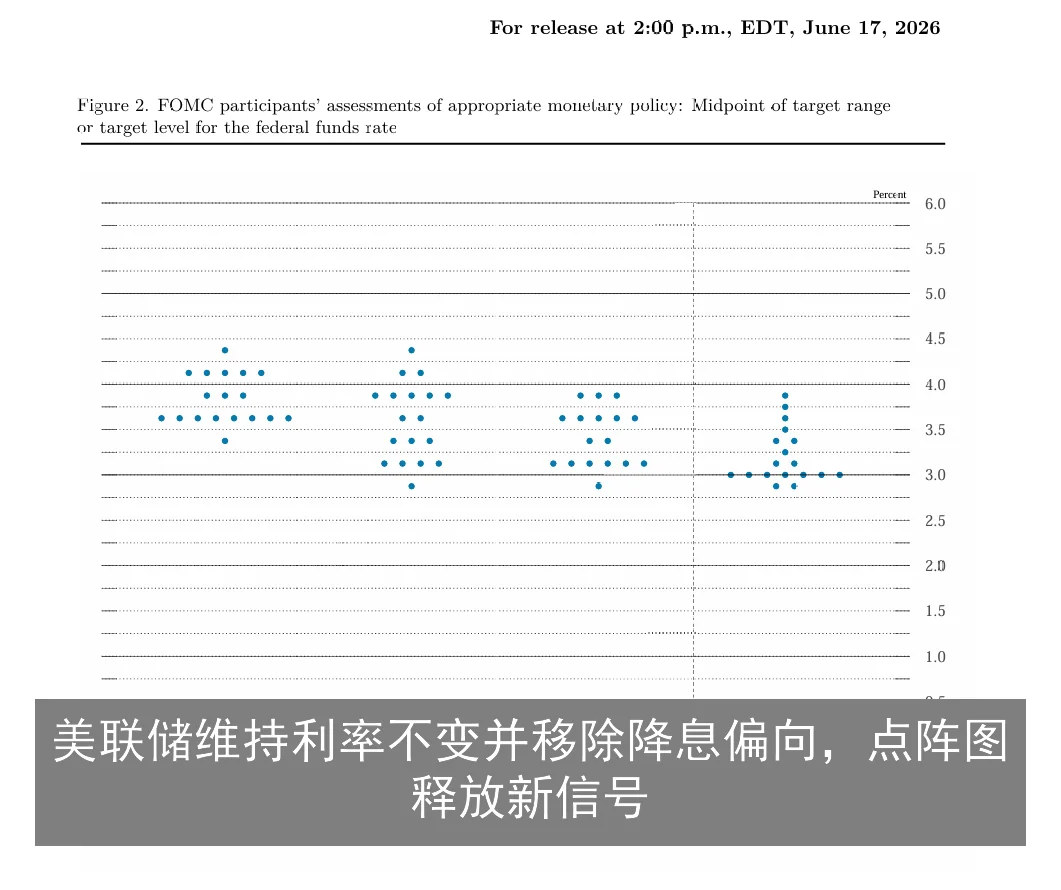
The Fed keeps rates unchanged and removes its easing bias; the dot plot sends a new signal
After Kevin Warsh chaired his first meeting as Federal Reserve chair, the Federal Open Market Committee (FOMC) unanimously decided to keep the benchmark overnight borrowing rate unchanged in the 3.5% to 3.75% range, remove key wording that suggested a future bias toward rate cuts, and significantly shorten the policy statement.
Since the central bank cut rates by a cumulative 0.75 percentage points in the second half of 2025, the federal funds rate has remained at this level. This meeting kept the year's rate decision pattern intact, but made notable changes in policy language, forecast guidance, and the outlook.
Dot plot shows rate-cut expectations disappearing
Fed officials used the closely watched dot plot to withdraw expectations for a rate cut this year, and hinted that a hike is possible, though not certain. Because the dot plot is an anonymous aggregation of expectations, market watchers cannot confirm whether the missing forecast came from Warsh, but before the meeting the market widely expected he would not participate in the Summary of Economic Projections (SEP).
The note attached to the forecast materials shows that 18 of the 19 participants submitted rate and economic forecasts. Notably, one point is also missing in the 2028 forecast.
Warsh has long criticized the dot plot and forward guidance in the SEP, arguing that such tools weaken policy flexibility.
Policy statement significantly shortened
In addition to removing wording that had previously implied a dovish bias, the post-meeting statement was heavily trimmed. The latest statement is only 130 words long, compared with 341 words after the April 29 meeting.
The statement briefly described the economy, saying that despite some uncertainty, economic activity continues to expand steadily, productivity growth and capital investment remain strong, employment growth keeps pace with labor-force growth, and the unemployment rate has changed little.
The statement also said inflation remains above the 2% target, partly because supply shocks pushed up prices in certain areas, including energy, and that the committee will remain committed to price stability.
In addition, the Fed said it will maintain a policy of "ample reserves" in the banking system, meaning there is no immediate plan to reduce its $6.7 trillion balance-sheet holdings of bonds.
Inflation and growth expectations adjusted together
Against a backdrop of rising uncertainty about the rate outlook, officials also adjusted the future policy path. The dot plot erased the previous expectation of one cut this year and pushed any cuts back to 2027 and 2028, as policymakers assess whether the inflation spike triggered by the Iran war is persistent.
The dot plot shows a median year-end federal funds rate forecast of 3.8%, about 0.16 percentage points above the current level, indicating that hikes are also being considered. Officials still expect the long-run federal funds rate to be 3.1%.
In the latest economic projections, the Fed raised its 2026 headline inflation forecast to 3.6% and its core inflation forecast to 3.3%; in March both forecasts were 2.7%. At the same time, the 2026 GDP growth forecast was slightly lowered to 2.2%, while the unemployment forecast was lowered to 4.3%.
Markets and data keep widening the split
Recent inflation readings have hit multi-year highs. The May Consumer Price Index (CPI) showed annualized inflation at 4.2%, while core CPI was 2.9%. Over the past five years, inflation has remained above the Fed's 2% target.
Warsh previously said policy should usually look through supply-shock inflation and argued that artificial intelligence may ultimately create disinflation by raising productivity. However, the strong labor market makes the case for rate cuts more complicated. Nonfarm payrolls rose by 172,000 in May, and the unemployment rate has held at 4.3% over the past year.
Market pricing is aligned with FOMC expectations. According to CME's FedWatch tool, the market expects no rate cuts in 2026 and is pricing in a 25-basis-point hike by year-end.
