


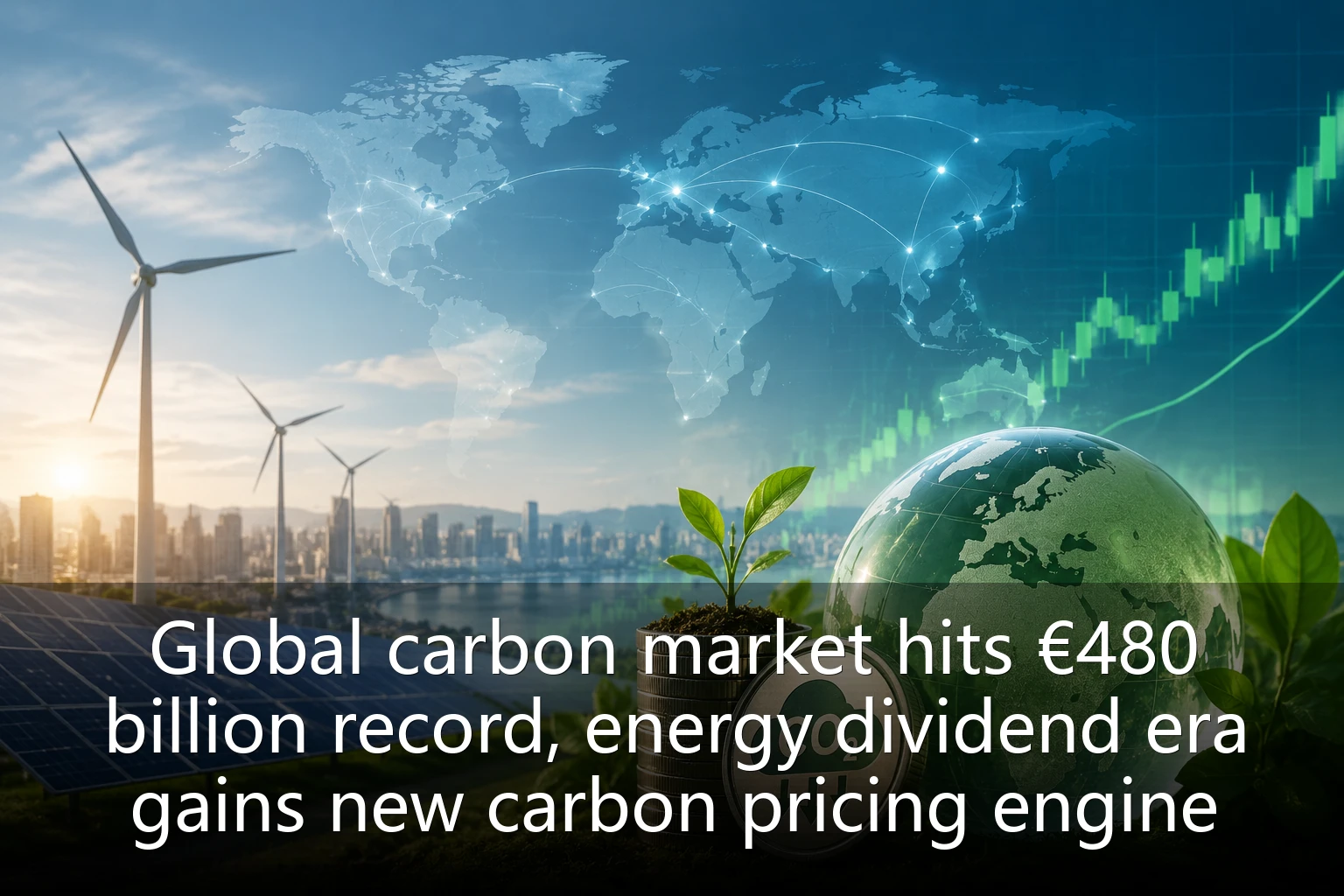
On July 31, 2026, the International Carbon Action Partnership (ICAP) released its latest annual report showing that in the first half of 2026, the global carbon emissions trading market reached a record high, with total trading value hitting €480 billion, up 42% year-on-year. This data not only underscores the further consolidation of the carbon market's central role in global climate governance, but also signals that the energy dividend period is welcoming a new growth engine driven by carbon pricing.
Global carbon market expands rapidly, emerging economies join collectively
The report notes that as of the end of June 2026, 46 countries and 34 regions worldwide had implemented carbon pricing mechanisms, covering over 30% of global greenhouse gas emissions. Notably, emerging economies such as Brazil, India, and Turkey officially launched national carbon markets in the first half of 2026, shifting the carbon pricing system from the traditional Europe-US dominated pattern toward global multipolarization.
Brazil's carbon market covered high-energy-consuming sectors such as power, cement, and steel in its first round of trading, with a total allowance volume of about 800 million tons. India, after pilot programs in selected states, expanded nationwide to cover chemicals, papermaking, aluminum, and other sectors. ICAP Secretary-General Tom Williams stated: "The entry of emerging markets is the most decisive step for the global carbon market. Within the next five years, global carbon pricing mechanisms will cover more than half of global emissions."
Rising carbon prices reshape energy investment logic
The expansion of the carbon market and the simultaneous rise in carbon prices are profoundly changing the revenue models of energy projects. In the first half of 2026, the average price of EU carbon allowances climbed to €92 per ton, up 28% year-on-year. Meanwhile, the average price across major global carbon markets rose 30% compared to the same period last year.
For renewable energy projects, carbon revenue is shifting from a "bonus" to a "core variable." According to estimates from the London Stock Exchange Group (LSEG), in mature European and American markets, the additional income from selling carbon credits in solar and wind projects now accounts for 15% to 25% of total project revenue. This means that, amid expectations of continued carbon price increases, the internal rate of return (IRR) of renewable energy projects is expected to rise by 2 to 4 percentage points.
Synergy between carbon market and green power trading
A notable new trend is the increasingly close linkage between the carbon market and green certificate/green power trading mechanisms. In major economies such as China and the EU, companies purchasing green power can also obtain certified carbon emission reductions, further stimulating demand for renewable energy consumption. An analyst from an international energy consultancy noted: "Carbon pricing creates a stable price signal for clean energy, significantly enhancing the predictability of investment returns. This is a key foundation for the continued expansion of the energy dividend period."
Industry interpretation: energy dividend period enters a 'twin-engine' stage
If the past energy dividend period was driven mainly by policy subsidies and installed capacity growth, the growth of the carbon market is now injecting market-oriented and financialized momentum into this phase. The carbon cost of traditional fossil energy continues to rise, while clean energy gains an increasingly clear competitive advantage with the support of carbon revenue.
BloombergNEF, an energy industry research institution, stated in its latest commentary that the global carbon market is becoming the second-largest environmental commodity after oil. For investors, the financial nature of the carbon market means that beyond investing in physical assets such as solar, wind, and energy storage, carbon allowances and carbon financial derivatives also represent a new asset allocation direction.
Investment opportunities and risk warnings
In the face of the new stage of energy dividends driven by the carbon market, investors can focus on the following directions:
- Carbon asset management service providers: As the carbon market expands, demand for professional services such as corporate carbon accounting, carbon consulting, and carbon trading brokerage is surging, bringing growth opportunities to relevant software platforms and companies.
- Integrated renewable energy + carbon operators: Companies with both power generation assets and carbon asset management capabilities can achieve dual returns during the carbon price upcycle.
- Carbon credit development projects: Especially voluntary emission reduction projects based on renewable energy and methane recovery, whose value is expected to be revalued under global carbon price linkage mechanisms.
However, risks also need attention. Carbon price fluctuations are highly influenced by policy, connections between different markets are still poor, and financial innovation in carbon markets may lead to regulatory arbitrage and other hidden dangers. Investors should align with their own risk preferences and make dynamic asset allocations when positioning themselves.
Conclusion: a new narrative for the energy dividend period
With a half-year performance of €480 billion, the global carbon market has declared its position as a core tool for the energy transition. From power to industry, and from developed countries to emerging economies, carbon pricing is weaving an increasingly dense network of interests, transforming emission reduction pressure into clean energy investment opportunities. For energy practitioners and investors alike, understanding the carbon market holds the key to the second half of the energy dividend period.
