


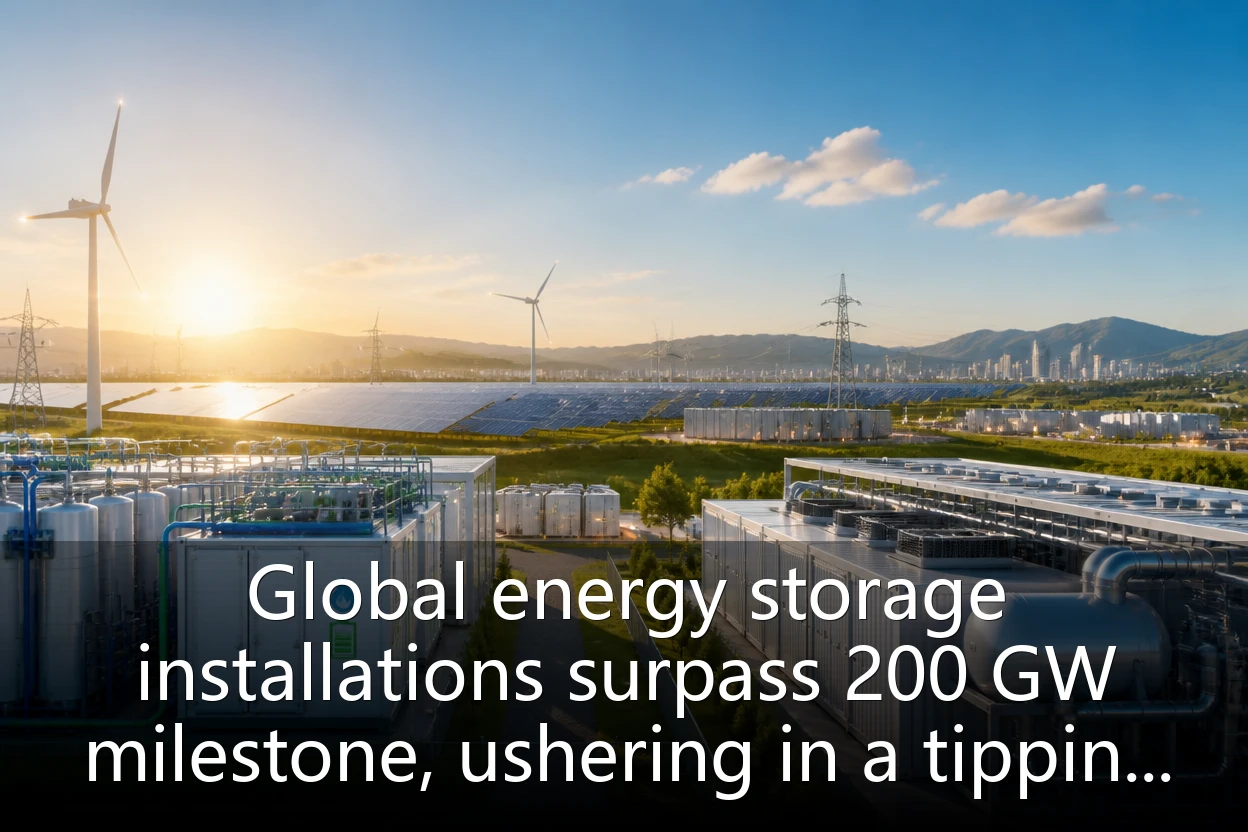
Energy Storage Installations Cross Milestone, Energy Dividend Enters the "Second Half"
In August 2026, the global energy transition reached a quiet yet pivotal juncture. According to the latest statistics released by the Global Energy Storage Alliance (GESA) in collaboration with multiple energy consultancies, cumulative global energy storage installations officially surpassed the 200 GW mark by the end of the second quarter of 2026, a year-on-year increase of over 35%. This figure not only marks energy storage's formal promotion from "supporting facility" to a core asset of the renewable energy system, but also signals a profound shift in the focus of the energy dividend era—from upstream manufacturing and installation to midstream and downstream operations, regulation, and value capture.
Unlike the market's heavy focus on 2-hour short-duration storage before 2025, new installations in the first half of 2026 saw the share of long-duration storage (4 hours and above) exceed 40% for the first time. Behind this structural change lies the hard demand for deep decarbonization of global power systems and the urgent need for uninterrupted, highly reliable green power backup for AI computing centers. The investment logic of the energy dividend era is evolving from expanding "quantity" to optimizing "quality" and deepening service capabilities.
Technology Pathways Converge: Flow Batteries and Compressed Air Energy Storage Take Center Stage
Within the 200 GW installed base, lithium-ion batteries still hold the dominant share, but their dominance is being eroded by emerging technologies. All-vanadium redox flow batteries and iron-chromium flow batteries achieved grid connection or construction starts for multiple hundred-megawatt-scale projects in the first half of 2026, marking a significant acceleration in the commercialization of non-lithium technology pathways.
In late July, a 400 MW/1600 MWh all-vanadium redox flow battery energy storage station in Karamay, Xinjiang, reached full capacity grid connection, making it one of the largest single-site long-duration energy storage facilities currently in operation globally. The project leverages Xinjiang's abundant wind and solar resources for charging, providing up to 4 hours of stable power output during evening peak hours, effectively alleviating local grid peak-shaving pressure. Meanwhile, two large compressed air energy storage stations in Feicheng, Shandong, and Jintan, Jiangsu, also entered full-load trial operation in the first half of the year, each with a unit capacity of 300 MW and a levelized cost of electricity approaching that of pumped hydro storage.
"The cost reduction curve for long-duration energy storage is steeper than expected," noted an industry analyst who wished to remain anonymous. "With the promotion of vanadium electrolyte leasing models and the localization of core compressed air equipment, the lifecycle levelized cost of electricity has fallen below 0.2 yuan per kWh. This provides economic feasibility for converting large amounts of curtailed wind and solar power into dispatchable electricity, directly expanding the effective generation hours and revenue boundaries of renewable energy projects."
AI Computing Power Creates Rigid Demand for "Storage + Computing"
Another major engine driving the above-expectation growth in energy storage installations is the energy anxiety of AI computing centers. In 2026, global data center electricity consumption is approaching the predicted red line of 5% of global power consumption, with multiple tech giants explicitly identifying "stable and clean power supply" as the primary bottleneck for AI business expansion in their financial reports.
Against this backdrop, cloud providers like Microsoft, Google, and Amazon intensively signed ultra-long-term energy storage power purchase agreements in the first half of 2026 and directly participated in investing in multiple large-scale independent energy storage stations. These projects are no longer mere attachments to solar or wind farms but are designed as "computing infrastructure" themselves. For example, a 200 MW/800 MWh independent energy storage project invested in by Microsoft in Iowa has the core function of providing 24/7 green power matching and millisecond-level frequency response for its regional data center cluster.
This deep integration of "computing + storage" gives energy storage assets a new pricing model. The revenue sources for energy storage stations have expanded from relatively single peak-valley arbitrage and ancillary service compensation to include high-premium "green power + reliability" service packages for high-value loads. This significantly enhances the internal rate of return for high-quality energy storage projects and attracts more private equity and infrastructure funds to enter the market.
Policy and Market Mechanisms Resonate: Independent Market Status for Energy Storage Established
The explosion of the energy storage industry in 2026 is inseparable from the maturation of policies and market mechanisms. The electricity spot market reform fully implemented in China at the end of 2025 entered a phase of deepened operation in the first half of 2026. Spot market price spreads widened further in multiple provinces, with the number of provinces where the maximum daily peak-valley price difference exceeded 1.5 yuan/kWh increasing, providing clear arbitrage space for energy storage.
More importantly, in the new version of the "Rules for New Energy Storage Participating in Electricity Market Trading" released by the National Energy Administration in June 2026, independent energy storage stations were explicitly granted dual market participant status for the first time, on both the "generation side" and the "consumption side," allowing them to simultaneously participate in the energy market, ancillary services market, and capacity market. This top-level design cleared the "last mile" for the commercial profitability of energy storage, enabling the value of energy storage assets to be priced by the market.
In Europe, the full implementation of the third phase of the EU Carbon Border Adjustment Mechanism further internalized carbon costs for energy-intensive industries. To avoid carbon tariffs, corporate demand for green electricity and green certificates surged, and deploying energy storage is a necessary means to stabilize green power. The UK and Germany increased capacity auction subsidies for long-duration energy storage in the summer of 2026 to address system security challenges posed by the volatility of renewable energy output.
Value Roadmap: Shifting from Manufacturing to Operations
For energy investors, the milestone of global energy storage installations surpassing 200 GW and the explosion of long-duration energy storage technologies mean the value roadmap for the energy dividend era has clearly shifted. In recent years, investing in solar photovoltaic and lithium battery manufacturing yielded huge returns, but as the industry enters a capacity digestion cycle, profit margins in the manufacturing segment are being compressed. Energy storage operations, asset management, and core technology provision are becoming new value pools.
Specifically, three directions are worth watching: first, equipment providers with advanced core long-duration energy storage technologies and large-scale delivery capabilities; second, energy storage asset operators with cross-regional, multi-asset collaborative operation capabilities, who can maximize the capture of electricity price spreads and ancillary service revenues through algorithmic optimization; third, digital platforms providing software services such as intelligent temperature control, safety early warning, and power trading decisions for energy storage systems. The gross margins of these segments are far higher than simple battery assembly, with higher technological barriers and customer stickiness.
The global energy transition has entered deep waters. Achieving carbon neutrality goals no longer depends solely on how many wind turbines and solar panels we install, but more on our ability to make volatile green power reliable, controllable, and economical. Energy storage, especially long-duration energy storage, is the key to solving this puzzle. 200 GW is just a new starting point; the most lucrative returns of the energy dividend era may just be beginning to emerge.
